
Talazac's shrew tenrec
Nesogale talazaci
First described in 1896 by Forsyth Major, Talazac’s Shrew Tenrec is notable among its relatives for occurring across a broad elevational and vegetation range, from lowland rainforest to high montane zones in eastern Madagascar.
- NE
- DD
- LCCurrent status: Least Concern
- NT
- VU
- EN
- CR
- RE
- EW
- EX
Current status: Least Concern
What does this mean?
The assessment found a lower risk of extinction.
Categories follow the IUCN Red List.- Kingdom
- Animalia
- Phylum
- Chordata
- Class
- Mammalia
- Order
- Afrosoricida
- Suborder
- Tenrecomorpha
- Family
- Tenrecidae
- Subfamily
- Oryzorictinae
- Genus
- Microgale
- Subgenus
- Nesogale
- Species
- Nesogale talazaci
- Species group
- Tenrec
Get to know this species
Biology & ecology
Habitat
It occupies moist lowland and montane forests across elevations from sea level up to around 2,300 m. While typically found in primary rainforest, it may tolerate some disturbance but tends to be absent from heavily cleared forests.
Physical traits
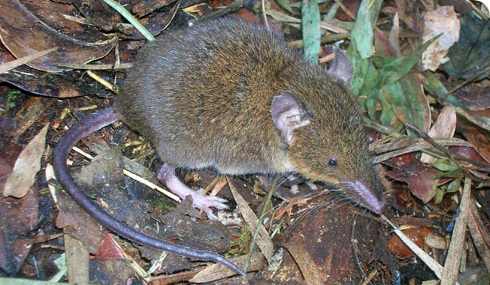
Talazac’s Shrew Tenrec is medium-large among shrew tenrecs, with a head‑body length of about 100–128 mm, a tail up to 150 mm, and adult weight averaging around 34–38 g. Its spindle-shaped body is covered in soft, dark to reddish‑brown fur above and paler buff‑grey beneath. The tail is long and slender, extending beyond the body length. With a pointed muzzle and robust limbs, its appearance reflects both ground-dwelling and occasional climbing abilities, although its morphology is more robust compared to its relatives.
Behavior
Talazac’s Shrew Tenrec is nocturnal and primarily terrestrial, using leaf litter paths and tunnels under debris for navigation. Though mostly ground dwelling, individuals are occasionally observed climbing low vegetation or roots. It moves through forest quietly, relying on scent and tactile cues to explore and hunt. Territorial and solitary habits are inferred, with only brief territorial encounters documented. No formal studies exist on home range or nesting behavior.
Diet
This species feeds on a variety of invertebrates, including beetles, grasshoppers, larvae, and occasionally small frogs captured opportunistically. It forages through soil and litter, using sharp muzzle movements and forepaws to extract prey, and will even consume smaller tenrecs when trapped alongside them. Prey detection relies heavily on scent and exploratory digging behavior.
Reproduction
Reproductive biology has been studied only in captivity. Gestation lasts approximately 62–63 days, and litters range from one to five young. Offspring are born naked and blind, eyes opening after about three weeks, and reach maturity after approximately three months. Wild reproduction timing and juvenile development remain largely undocumented.
Communication
Direct studies on communication are lacking. Like its relatives, it likely relies on scent marking and tactile signals during short encounters or maternal care. Vocalizations have not been documented, but soft squeals during aggression or mating may occur.
Threats
Talazac’s Shrew Tenrec is classified by the IUCN as Least Concern, owing to its relatively wide distribution and occurrence in multiple protected forest areas. Nevertheless, the population is believed to be declining due to deforestation, habitat fragmentation, mining and agricultural expansion. While some human-modified forest edges are tolerated, intact forest remains crucial for survival .
This species as pets
There are no currently known records of Talazac’s Shrew Tenrec being maintained or bred in captivity. No zoo or private collection is known to house it, and no husbandry or care protocols have been developed. Its adaptability to captivity remains unexplored.
Where does it live?
This species is endemic to eastern Madagascar, spanning from northern areas like Montagne d’Ambre and Masoala Peninsula down through central-east regions including Ambatovy, Analamazaotra, and Ranomafana, with one isolated record near Ambohitantely.
Linked Knowledge Hub articles
No linked public Knowledge Hub articles yet.
Linked research
No linked public research records yet.
Sources
Referenced sources
- Stephenson, P.J., Soarimalala, V. & Goodman, S. 2016. Microgale talazaci. The IUCN Red List of Threatened Species 2016: e.T41315A97202475. https://dx.doi.org/10.2305/IUCN.UK.2016-1.RLTS.T41315A97202475.en. Accessed on 17 October 2026. Open source