
Major's long-tailed shrew tenrec
Microgale majori
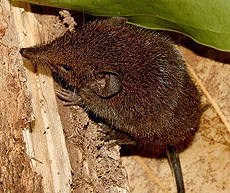
First described in 1918 by Thomas, Major’s Long‑tailed Tenrec stands out among its relatives for having a tail nearly twice as long as its body, a notably graceful feature unusual in Microgale.
- NE
- DD
- LCCurrent status: Least Concern
- NT
- VU
- EN
- CR
- RE
- EW
- EX
Current status: Least Concern
What does this mean?
The assessment found a lower risk of extinction.
Categories follow the IUCN Red List.- Kingdom
- Animalia
- Phylum
- Chordata
- Class
- Mammalia
- Order
- Afrosoricida
- Suborder
- Tenrecomorpha
- Family
- Tenrecidae
- Subfamily
- Oryzorictinae
- Genus
- Microgale
- Species
- Microgale majori
- Species group
- Tenrec
Get to know this species
Biology & ecology
Habitat
Found primarily in the eastern humid forests and also in some drier western forests at elevations ranging from about 785 to 2,000 m. It occupies both lowland and montane rainforest zones, and may tolerate habitat disturbance to some degree. Though widely distributed from the north to the south of the island, its precise habitat preferences and population densities are still little studied.
Physical traits
Weighing approximately 5.6 to 7.5 g and measuring about 6.3 to 7.2 cm in head‑body length, Major’s Long‑tailed Tenrec possesses a remarkably long tail (11.5–12.9 cm), nearly double its body length. Its body is spindle-shaped with dense dark brown dorsal fur and a darker grey underbelly, sometimes with reddish or yellowish tints. Ears are relatively large (13–15 mm), and it has strong forelimbs and an elongated outer toe, features suggesting some time spent climbing.
Behavior
Little is known about the species’ behavior because it is rarely observed. Morphological traits such as a very long tail and strong limbs suggest partially scansorial habits, climbing branches and foraging both on the ground and low in trees. Observational data are lacking, but it likely shares a secretive, mostly terrestrial lifestyle similar to other shrew tenrecs, occasionally using burrows or litter for shelter.
Diet
Dietary data for this tenrec are not available; however, intestinal content analyses suggest an insectivorous diet typical of shrew tenrecs, feeding on invertebrates like insects and earthworms. Its morphology aligns with ground‑foraging behavior in rich leaf‑litter environments.
Reproduction
Virtually nothing is known about Major’s Long‑tailed Tenrec reproduction. The species has not been studied in captivity, and no observations exist regarding gestation length, litter size, breeding seasonality or juvenile development. It may follow general patterns seen in other shrew tenrecs, but specifics remain entirely undocumented.
Communication
No species‑specific studies on Major’s Long‑tailed Tenrec’s communication exist. It is presumed to rely on scent marking and tactile signals during brief interactions or maternal care, similar to behavior found in other shrew tenrec relatives. No vocalizations or ultrasonic cues have been documented.
Threats
It has a relatively wide range and occurrence in numerous protected forests, including Manongarivo, Ambohitantely, Andrahomana and Andringitra. Nonetheless, habitat loss through deforestation, land-use change and fire continues across its range. Population trends remain unclear, and comprehensive field studies will be necessary for long-term conservation assessment.
This species as pets
No records exist of the species being kept or bred in captivity. It is not maintained in zoos or private collections, and no husbandry protocols are documented. Its tolerance of or adaptation to captivity remains completely unknown.
Where does it live?
Major’s Long‑tailed Tenrec is endemic to Madagascar.
Linked Knowledge Hub articles
No linked public Knowledge Hub articles yet.
Linked research
No linked public research records yet.
Sources
Referenced sources
- Stephenson, P.J., Soarimalala, V. & Goodman, S. 2016. Microgale majori. The IUCN Red List of Threatened Species 2016: e.T62016A97200480. https://dx.doi.org/10.2305/IUCN.UK.2016-1.RLTS.T62016A97200480.en. Accessed on 16 October 2026. Open source