
Lesser long-tailed shrew tenrec
Microgale longicaudata
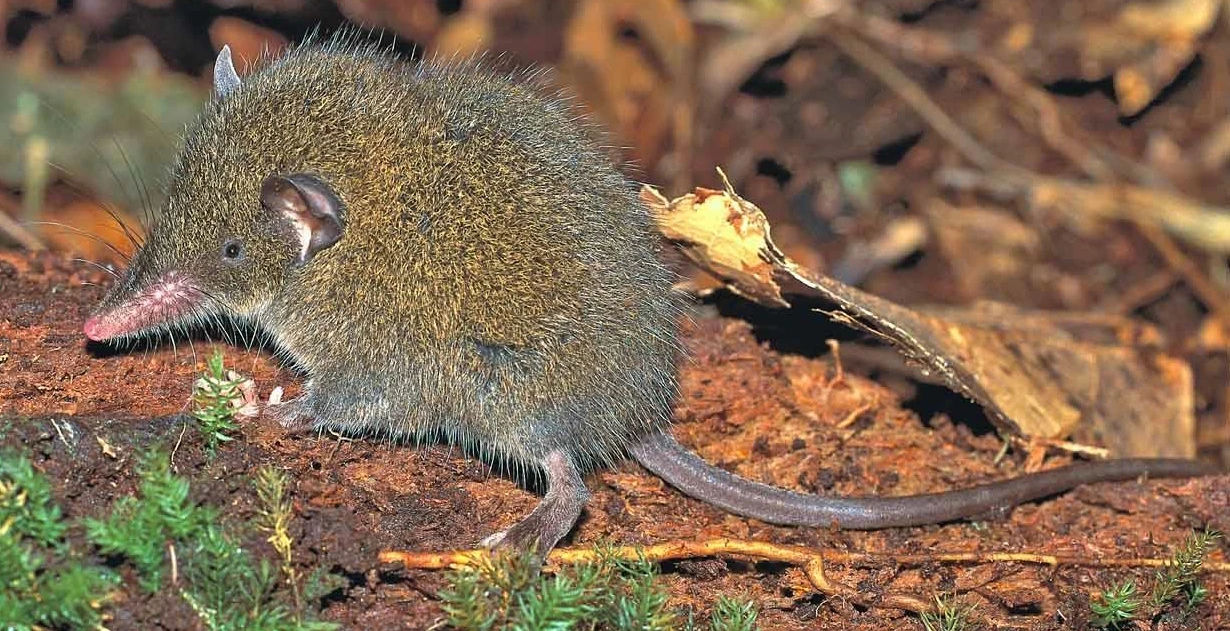
First described in 1882 by Thomas, the Lesser Long‑tailed Shrew Tenrec is unique among its relatives for possessing a very long prehensile tail that is typically far longer than its body length.
- NE
- DD
- LCCurrent status: Least Concern
- NT
- VU
- EN
- CR
- RE
- EW
- EX
Current status: Least Concern
What does this mean?
The assessment found a lower risk of extinction.
Categories follow the IUCN Red List.- Kingdom
- Animalia
- Phylum
- Chordata
- Class
- Mammalia
- Order
- Afrosoricida
- Suborder
- Tenrecomorpha
- Family
- Tenrecidae
- Subfamily
- Oryzorictinae
- Genus
- Microgale
- Species
- Microgale longicaudata
- Species group
- Tenrec
Get to know this species
Biology & ecology
Habitat
The species resides at elevations ranging from about 530 up to 2,500 m. It is found in both lowland and montane rainforest, and tolerates some habitat disturbance, persisting in partially degraded forest areas. Though its distribution is relatively extensive, detailed information on preferred microhabitats and density remains limited.
Physical traits
Weighing approximately 6 to 11 g and measuring 59–80 mm in head–body length, the tail is exceptionally long at 136–158 mm, more than twice body length. Its soft, dense dorsal coat is reddish‑brown, with a pale grey underside often tinged buff, and the tail is distinctly grey‑brown above and reddish buff below. Hindfeet and digits are elongated, aiding its semi‑arboreal habits, and the tail’s tip is partly naked and covered with broad transverse scales, features unusual even among tree-climbing tenrecs.
Behavior
The Lesser Long‑tailed Shrew Tenrec is active both day and night; individual animals follow their own activity/rest cycles rather than a uniform rhythm. Its morphology suggests a scansorial lifestyle, climbing small branches and foraging both on the ground and low in the trees. One captive individual began activity around 18:30 and returned to a leaf-litter nest at about 5 cm diameter for daytime rest, a pattern that likely reflects its wild behavior, but broader behavioural data are lacking.
Diet
This tenrec forages mainly in forest litter for soil invertebrates like beetles, spiders, ants, grasshoppers and even amphipods. In captivity it accepted insects up to 6 cm long, using its tail and hindfeet to brace while handling prey, emphasizing its ground‑foraging efficiency. No seasonally or habitat-specific diet studies exist for this species.
Reproduction
Little reproductive information is available. One wild-caught female collected in November showed two placental scars, suggesting a small litter typical of related species. Gestation, litter size, timing and juvenile development remain unstudied for this species, though general patterns in relatives offer a rough guideline.
Communication
There are no dedicated studies of communication in this species. It is presumed like other shrew tenrecs to rely on scent marking and tactile cues during brief interactions or maternal care. Vocalizations such as squeals or ultrasonic signals may occur but remain undocumented.
Threats
This species loves in broad range and has a presence in multiple protected forest areas. However, its population appears to be decreasing, and it is threatened by ongoing habitat loss from logging, agricultural clearing and fire. Continued monitoring and field studies are needed to clarify its long‑term resilience and population trends.
This species as pets
There are no reliable records of the Lesser Long‑tailed Shrew Tenrec being kept or bred in captivity. No husbandry protocols or zoo collections are known to include this species, and its response to captive conditions remains unknown.
Where does it live?
This species is endemic to Madagascar and occurs widely across the northern, central highland, eastern and southeastern humid forests.
Linked Knowledge Hub articles
No linked public Knowledge Hub articles yet.
Linked research
No linked public research records yet.
Sources
Referenced sources
- Stephenson, P.J., Soarimalala, V. & Goodman, S. 2016. Microgale longicaudata. The IUCN Red List of Threatened Species 2016: e.T13344A97200213. https://dx.doi.org/10.2305/IUCN.UK.2016-1.RLTS.T13344A97200213.en. Accessed on 16 October 2026. Open source