
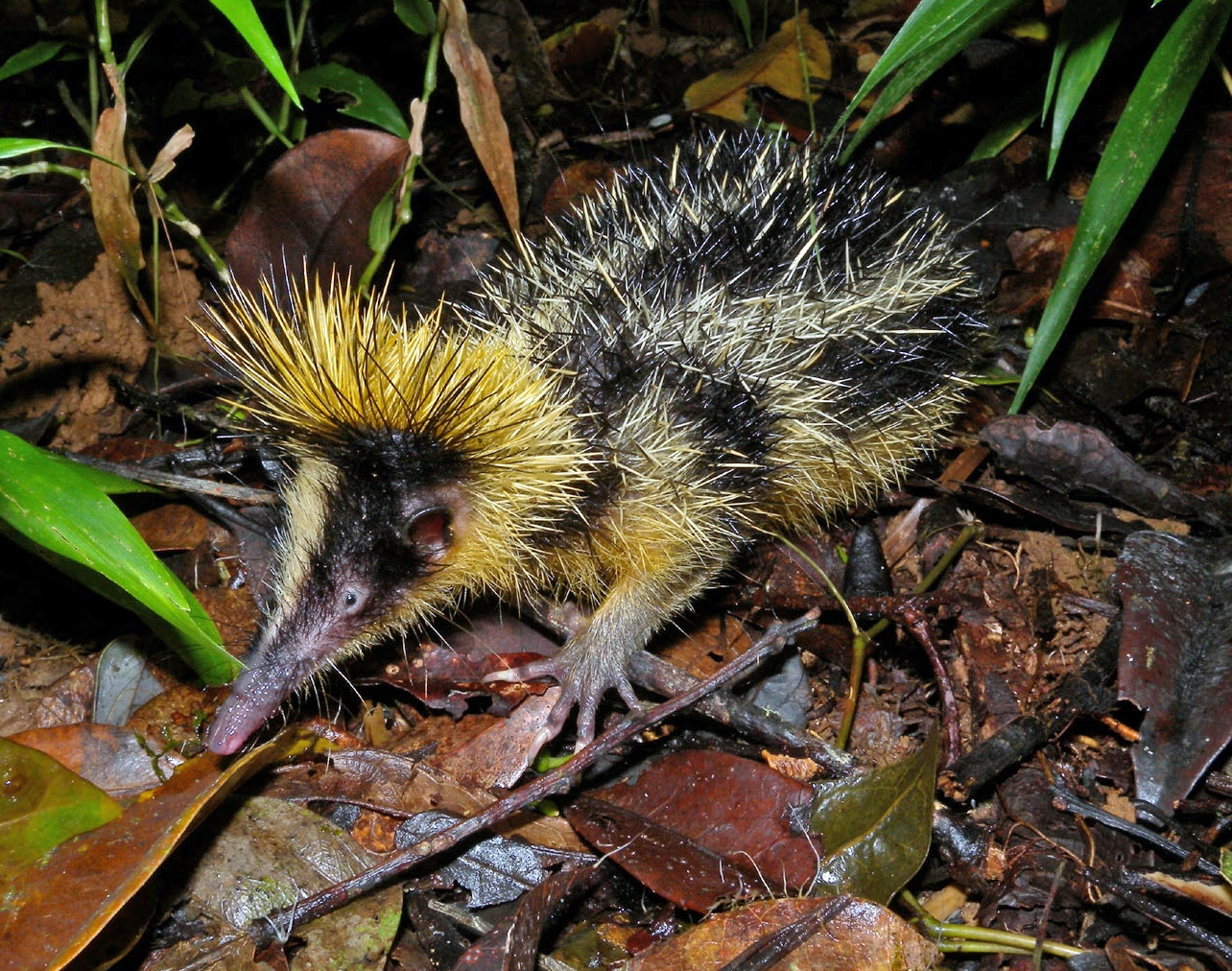
Lowland streaked tenrec
Hemicentetes semispinosus
First described in 1798 by Cuvier, the Lowland Streaked Tenrec is notable among its relatives for being the only mammal known to stridulate, rubbing specialized quills together to produce ultrasonic sounds for communication.
- NE
- DD
- LCCurrent status: Least Concern
- NT
- VU
- EN
- CR
- RE
- EW
- EX
Current status: Least Concern
What does this mean?
The assessment found a lower risk of extinction.
Categories follow the IUCN Red List.- Kingdom
- Animalia
- Phylum
- Chordata
- Class
- Mammalia
- Order
- Afrosoricida
- Suborder
- Tenrecomorpha
- Family
- Tenrecidae
- Subfamily
- Tenrecinae
- Tribe
- Tenrecini
- Genus
- Hemicentetes
- Species
- Hemicentetes semispinosus
- Species group
- Tenrec
Get to know this species
Biology & ecology
Habitat
It also ventures into secondary forests, shrubby edges, gardens, farmland, and even anthropogenic clearings, demonstrating a high tolerance for human-altered landscapes. Known for forming social groups in interconnected burrow systems, it is the most gregarious of tenrecs and sometimes lives in colonies of up to 20 individuals.
Physical traits
Adults typically measure around 140 mm in body length (up to ~170 mm) and weigh between 125 and 280 g. Their dorsal coat features alternating black and yellow stripes along the body and head, with barbed quills that can detach when used defensively. They lack a tail, and sensory hairs on their back serve a tactile function. The skull and limb morphology support semi‑fossorial foraging, with powerful forelimbs specialized for digging.
Behavior
Lowland Streaked Tenrecs are diurnal and social, foraging in family units for earthworms and soft-bodied invertebrates. They use forefoot stamping to coax worms to the surface and then dig them out with their sensitive snouts. These tenrecs often enter torpor during Madagascar’s winter (May–October), though they remain partially active by retreating to shared burrows. Stridulation of quills is used to communicate within groups or as warnings to predators.
Diet
Their diet is overwhelmingly vermivorous: mainly earthworms, insect larvae and soft-bodied invertebrates. They swallow prey whole or crush it gently, as their fragile jaws cannot tolerate hard food. In the wild, individuals may consume nearly their own body weight in worms per day.
Reproduction
Breeding takes place from November to May. Gestation lasts about 55–58 days, with average litter sizes of 5–8 pups, although as many as 11 have been recorded in captivity. Offspring are born naked and blind, develop quills within 24 hours, are weaned at 18–25 days, and reach sexual maturity as early as 25–40 days. Females can give birth during the same season they were born.
Communication
This species uniquely produces ultrasonic squeaks and chirps by rubbing quills together, inaudible to humans, that likely serve social cohesion, especially among family groups. They also use scent marking, foot stamping, and tactile signals in mating or territorial interactions.
Threats
The species is classified as Least Concern by the IUCN due to its wide distribution and versatility of habitat. Though adaptable, populations face ongoing threats from deforestation, agricultural expansion, and human hunting. Its range overlaps many protected areas.
This species as pets
While occasionally kept as an exotic pet, the Lowland Streaked Tenrec is difficult to maintain in captivity due to its highly specialized diet of live worms and other soft-bodied invertebrates. They may accept group housing, but feeding large quantities of live prey and providing burrowing substrate make captive care demanding. Lifespan in captivity typically does not exceed 2–3 years, and standardized husbandry protocols are lacking.
Where does it live?
This tenrec inhabits tropical lowland rainforests across eastern and northern Madagascar, from sea level up to about 1,550 m.
Linked Knowledge Hub articles
No linked public Knowledge Hub articles yet.
Linked research
No linked public research records yet.
Sources
Referenced sources
- Stephenson, P.J., Soarimalala, V. & Goodman, S. 2016. Hemicentetes semispinosus. The IUCN Red List of Threatened Species 2016: e.T40593A97189434. https://dx.doi.org/10.2305/IUCN.UK.2016-1.RLTS.T40593A97189434.en. Accessed on 17 October 2026. Open source