
Gracile shrew tenrec
Microgale gracilis
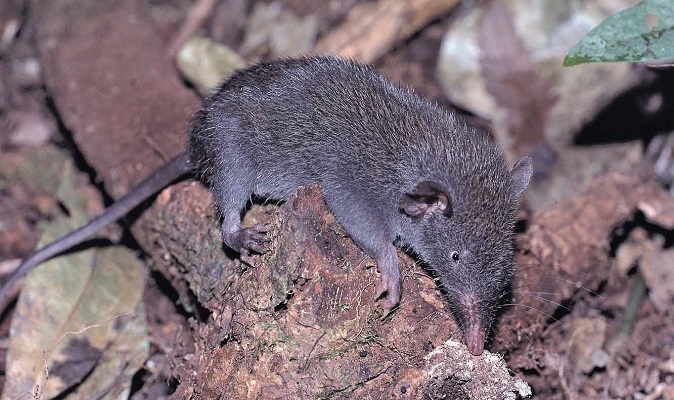
First described in 1896 by Forsyth Major, the Gracile Shrew Tenrec is distinctive among its congeners for its elongated, reticulated muzzle and broad forefeet adapted for semi‑fossorial life, a combination of traits rare in other Microgale species.
- NE
- DD
- LCCurrent status: Least Concern
- NT
- VU
- EN
- CR
- RE
- EW
- EX
Current status: Least Concern
What does this mean?
The assessment found a lower risk of extinction.
Categories follow the IUCN Red List.- Kingdom
- Animalia
- Phylum
- Chordata
- Class
- Mammalia
- Order
- Afrosoricida
- Suborder
- Tenrecomorpha
- Family
- Tenrecidae
- Subfamily
- Oryzorictinae
- Genus
- Microgale
- Species
- Microgale gracilis
- Species group
- Tenrec
Get to know this species
Biology & ecology
Habitat
It prefers humid montane forests at elevations between about 1,200 and 2,000 m, often occupying dense understory and valley-bottom habitats. Although known from a broad range of sites, its precise habitat preferences and population density patterns remain understudied .
Physical traits
This medium-sized shrew tenrec weighs roughly 20–25 g, with a head‑body length of 88–106 mm and a tail shorter than the body (60–87 mm). Its dense, velvety fur is dark brown with buff speckles on the back and a pale grey underside with a buff wash. Notable features include a slender, elongated skull ending in a reticulated muzzle, small eyes partly obscured by fur, and unusually broad forefeet with enlarged claws, all adaptations suggesting semi‑fossorial behavior. M. gracilis has a reduced dentition, with slender incisors and canines fitting its ground-dwelling lifestyle .
Behavior
Based on morphology, particularly the stout forefeet and elongated muzzle, this tenrec is presumed to forage at ground level and may dig or move through soft soil and leaf litter. It is likely solitary and secretive, with behavior typical of surface‑foraging species. However, direct observations on activity cycles, home‑range size and social interactions are lacking.
Diet
Dietary specifics are unavailable, but its morphology and reports of soil invertebrate feeding suggest it subsists primarily on insects such as beetles and worms. Like other shrew‑tenrecs, it likely hunts within leaf litter or shallow soil, though no isotopic or gut‑content studies are documented.
Reproduction
Very little is known regarding its reproductive biology. Occasional placental scars in females hint at seasonal breeding, likely following the rainy season. Given the trends in related Microgale, gestation probably lasts around eight weeks and litters may be small. Specific data on litter size, breeding frequency or juvenile development remain absent.
Communication
No focused studies exist on communication behaviors in M. gracilis. It is presumed to rely on scent marking and tactile signals during social interactions, especially maternal care or mating. Occasional squealing or ultrasonic sounds, documented in related species, may also occur, but remain unrecorded for this species.
Threats
It is presumed to have a relatively wide distribution and stable population. It occurs in several protected forests, including Marojejy, Ranomafana and Andringitra national parks. Habitat threat remains moderate owing to deforestation and agricultural expansion, particularly at lower elevations; however, the population is presumed resilient and adaptable to some habitat disturbance.
This species as pets
There are no records of Microgale gracilis being held or bred in captivity. As with many shrew tenrecs, no husbandry methods, captive breeding attempts or protocol documentation exist. Its responses to captivity and potential for ex situ conservation remain unknown.
Where does it live?
Endemic to Madagascar, Microgale gracilis occurs along the eastern portion of the island, from northern reserves like Marojejy and Anjanaharibe‑Sud, through the central high plateau, down to Andohahela in the south.
Linked Knowledge Hub articles
No linked public Knowledge Hub articles yet.
Linked research
No linked public research records yet.
Sources
Referenced sources
- Stephenson, P.J., Soarimalala, V. & Goodman, S. 2016. Microgale gracilis. The IUCN Red List of Threatened Species 2016: e.T13343A97191617. https://dx.doi.org/10.2305/IUCN.UK.2016-1.RLTS.T13343A97191617.en. Accessed on 15 October 2026. Open source