
Lesser hedgehog tenrec
Echinops telfairi
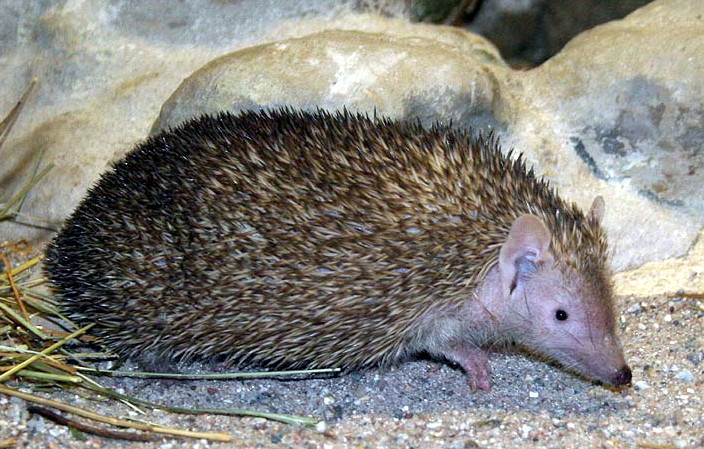
First described in 1838, the Lesser Hedgehog Tenrec is notable among its relatives for being the only tenrec that resembles a hedgehog and can enter prolonged torpor, slowing its metabolism and body temperature for months during Madagascar’s dry season.
- NE
- DD
- LCCurrent status: Least Concern
- NT
- VU
- EN
- CR
- RE
- EW
- EX
Current status: Least Concern
What does this mean?
The assessment found a lower risk of extinction.
Categories follow the IUCN Red List.- Kingdom
- Animalia
- Phylum
- Chordata
- Class
- Mammalia
- Order
- Afrosoricida
- Suborder
- Tenrecomorpha
- Family
- Tenrecidae
- Subfamily
- Tenrecinae
- Tribe
- Setiferini
- Genus
- Echinops
- Species
- Echinops telfairi
- Species group
- Tenrec
Get to know this species
Biology & ecology
Habitat
It inhabits a variety of dry landscapes including deciduous forests, savannas, shrublands, and even agricultural areas or coastal scrub. Although most common in arid zones, it tolerates fragmented habitats and can also be observed climbing low trees or shrubs near its nesting sites.
Physical traits
The Lesser Hedgehog Tenrec is a small, stout mammal, roughly 13 to 18 cm from nose to tail and weighing about 110–250 g (typically around 200 g). Its dorsal coat consists of sharp spines in hues from pale tan to dark brown, while the underside and limbs bear soft grey-white fur. The tail is short, ears are prominent, and long whiskers extend from its pointed snout. Eyesight is poor, but hearing, smell and tactile whiskers are well-developed.
Behavior
This tenrec is nocturnal and lives mostly alone, except for mothers caring for young or animals sheltering together during torpor. During the day, it rests in nests made of leaves and green material under logs or in tree hollows. In response to low food availability or cold conditions, individuals may enter torpor for three to five months, significantly slowing their metabolism to conserve energy.
Diet
Though generally considered insectivorous, the Lesser Hedgehog Tenrec is actually an opportunistic omnivore. It feeds primarily on insects, larvae, earthworms, and occasionally consumes small vertebrates such as bird eggs or mice, and eats fruits when available. Hunting occurs on the ground and in low branches, using claws and whiskers to locate prey in leaf litter.
Reproduction
Breeding typically begins in October after emerging from torpor. Gestation lasts about 60–68 days, and litters generally include 5–7 offspring—though as many as ten have been recorded. Newborns are naked and helpless, weighing around 8 g. Eyes open after roughly one week, and young become independent at 30–35 days old. Females rear the young alone in nests, and sexual maturity is typically reached after the first post-torpor season.
Communication
There are no formal studies on communication for this species. It likely uses a combination of scent marking, tactile signals, and possibly low-volume vocal or clicking sounds during mom–offspring interaction or brief encounters, much like its relatives.
Threats
The IUCN classifies this species as Least Concern, based on its relatively broad range and ecological flexibility. Despite this, habitat loss through deforestation, agricultural expansion, and increased human disturbance poses long-term risks. Populations appear stable in many areas, but continued habitat monitoring is important.
This species as pets
Unlike most other Malagasy tenrecs, the Lesser Hedgehog Tenrec is known from captive populations and is sometimes kept in the exotic pet trade. Historical breeding programs have succeeded in long-term husbandry, with observations on nutrition, torpor cycles, growth and development documented. However, wild-based captive-release programs or conservation breeding protocols are not well developed.
Where does it live?
This species is endemic to Madagascar, primarily occurring in southern and southwestern regions.
In the Registry
Anonymous totals from public registered records.
- Registered animals
- 1
- Male
- 0
- Female
- 1
- Unknown sex
- 0
- Litters · all time
- 0
- Litters · last 12 months
- 0
- Active public programmes
- 1
Linked Knowledge Hub articles
No linked public Knowledge Hub articles yet.
Linked research
No linked public research records yet.
Sources
Referenced sources
- Stephenson, P.J., Soarimalala, V. & Goodman, S. 2016. Echinops telfairi. The IUCN Red List of Threatened Species 2016: e.T40592A97188634. https://dx.doi.org/10.2305/IUCN.UK.2016-1.RLTS.T40592A97188634.en. Accessed on 17 October 2026. Open source