
North African hedgehog
Atelerix algirus
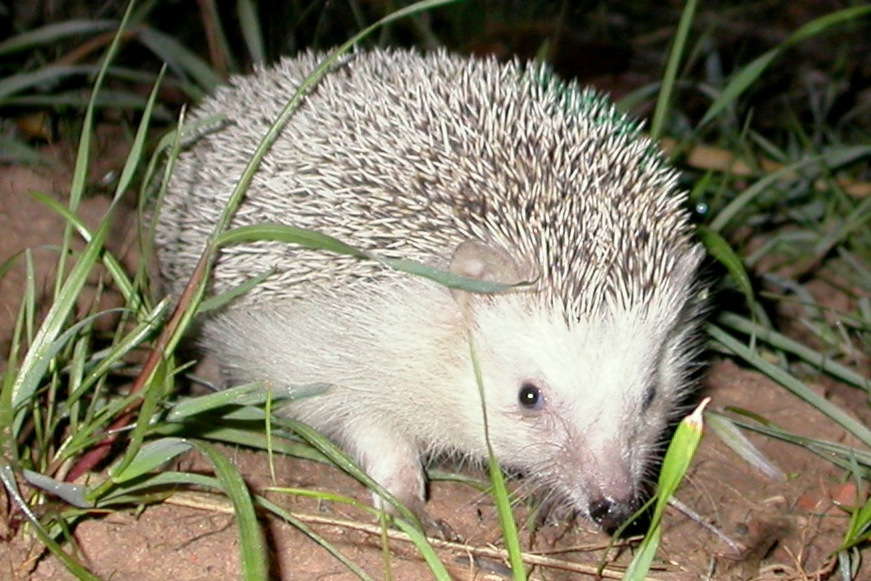
First described in 1840 by Lereboullet. It is the only hedgehog species that occurs both in North Africa and on several Mediterranean islands. Its pale spines and white facial fur make it easy to distinguish from most other Atelerix species.
- NE
- DD
- LCCurrent status: Least Concern
- NT
- VU
- EN
- CR
- RE
- EW
- EX
Current status: Least Concern
What does this mean?
The assessment found a lower risk of extinction.
Categories follow the IUCN Red List.- Kingdom
- Animalia
- Phylum
- Chordata
- Class
- Mammalia
- Order
- Eulipotyphla
- Family
- Erinaceidae
- Subfamily
- Erinaceinae
- Genus
- Atelerix
- Species
- Atelerix algirus
- Species group
- Hedgehogs
Get to know this species
Biology & ecology
Habitat
Its presence in Spain is considered to be the result of ancient human-mediated introduction, possibly dating back to Roman times. This species thrives in Mediterranean climates, occupying a wide range of habitats such as dry scrublands, grasslands, forest edges, and even suburban gardens and agricultural areas. It shows a notable tolerance for disturbed environments and is often found near human settlements, provided that some natural cover, such as hedges or stone walls, is available for shelter. The hedgehog avoids overly arid desert interiors and dense forests, preferring semi-open areas with both foraging opportunities and nesting sites.
Physical traits
The North African Hedgehog is medium-sized compared to other hedgehog species, typically reaching a length of 20 to 25 centimeters and weighing between 400 and 700 grams. It has relatively short legs…
Read full text
The North African Hedgehog is medium-sized compared to other hedgehog species, typically reaching a length of 20 to 25 centimeters and weighing between 400 and 700 grams. It has relatively short legs and a rounded body covered in creamy-white or pale brown spines, which are generally lighter than those of the European Hedgehog. One of the distinguishing features is the presence of a lighter-colored face and underbelly, often a soft cream or pale brown, along with a narrower and longer snout. The ears are relatively small and not as prominent as in desert-adapted species. Compared to its European cousin, it has fewer spines and more exposed skin on its belly. There is no strong sexual dimorphism, and seasonal weight variation occurs depending on food availability and temperature. Overall, it has a compact, agile appearance well-suited for warm climates.
Behavior
The North African Hedgehog is solitary and nocturnal, spending daylight hours resting in burrows, under rocks, or in dense vegetation. It becomes active shortly after dusk and forages throughout the …
Read full text
The North African Hedgehog is solitary and nocturnal, spending daylight hours resting in burrows, under rocks, or in dense vegetation. It becomes active shortly after dusk and forages throughout the night, returning to its shelter before sunrise. During hot summer days or periods of drought, individuals may enter short-term torpor to conserve energy and reduce water loss. Although it does not undergo prolonged hibernation like the European Hedgehog, it may reduce activity significantly in colder or drier months, especially in high-altitude areas. The species is territorial and will typically avoid direct encounters with conspecifics outside of the mating season. It is capable of traveling relatively large distances in search of food and suitable nesting sites, and is known for its adaptability to different environmental conditions.
Diet
The North African Hedgehog is an opportunistic feeder with a diet mainly composed of invertebrates. It consumes a variety of beetles, caterpillars, snails, slugs, ants, and other arthropods, as well …
Read full text
The North African Hedgehog is an opportunistic feeder with a diet mainly composed of invertebrates. It consumes a variety of beetles, caterpillars, snails, slugs, ants, and other arthropods, as well as small vertebrates like lizards, bird eggs, or occasionally carrion when available. It also supplements its diet with plant material such as fallen fruit or soft vegetation. In agricultural areas, it may benefit from increased insect populations and food waste, although pesticide use poses risks. Foraging behavior is mostly ground-based, involving sniffing and digging through leaf litter or topsoil. Seasonal variation in prey availability influences feeding patterns, and the hedgehog may travel greater distances during dry periods to find sufficient food. Water intake is usually obtained from moist prey or dew, as standing water is rarely used in the wild.
Reproduction
Breeding in the North African Hedgehog generally occurs in spring and early summer, though local climate can shift the exact timing. Courtship involves prolonged circling behavior accompanied by voca…
Read full text
Breeding in the North African Hedgehog generally occurs in spring and early summer, though local climate can shift the exact timing. Courtship involves prolonged circling behavior accompanied by vocalizations and scent-based communication. After successful mating, the female prepares a nest in a secluded location such as a burrow or under dense vegetation. Gestation lasts approximately 30 to 40 days, and the female gives birth to a litter of three to five hoglets. The young are born blind and without hardened spines, which develop within days. Eyes open around the second week, and weaning occurs after about four to six weeks. The mother is solely responsible for rearing the young, and males play no part in offspring care. Sexual maturity is reached within the first year, and in favorable conditions, a second litter may be produced before autumn. In the wild, lifespan is estimated to be three to five years, although captive individuals may live longer.
Communication
Communication in the North African Hedgehog is believed to be primarily olfactory, involving scent marking to establish territory and signal reproductive status. Like other hedgehogs, it likely posse…
Read full text
Communication in the North African Hedgehog is believed to be primarily olfactory, involving scent marking to establish territory and signal reproductive status. Like other hedgehogs, it likely possesses well-developed scent glands, although specific studies on gland structure in this species are limited. Acoustic communication includes hissing, snorting, and clicking sounds, particularly in aggressive or mating-related interactions. During courtship, vocalizations and scent trails play a significant role in facilitating mate recognition. Visual communication is minimal, as this species is primarily active in low-light conditions and relies heavily on smell and hearing. There are no dedicated studies on intraspecific communication in this species, so much of the available information is inferred from related hedgehog species.
Threats
While it faces some localized threats, its adaptability and broad range contribute to its relatively stable status. Habitat degradation due to urbanization, agricultural expansion, and infrastructure…
Read full text
While it faces some localized threats, its adaptability and broad range contribute to its relatively stable status. Habitat degradation due to urbanization, agricultural expansion, and infrastructure development can lead to the loss of nesting and foraging sites. Road mortality is increasingly common near human settlements. Use of pesticides and herbicides can reduce food availability and introduce toxins into the hedgehog’s system. In some areas, hedgehogs are persecuted due to cultural beliefs or killed by domestic pets. Despite these challenges, the species continues to persist in modified landscapes and often benefits from gardens, parks, and farmlands where shelter and prey are available. Long-term population trends remain poorly documented, and further research is needed to assess regional declines or pressures.
This species as pets
The North African Hedgehog is occasionally kept in captivity, especially in wildlife rehabilitation centers and zoos within its native range. It is not commonly found in the international pet trade, …
Read full text
The North African Hedgehog is occasionally kept in captivity, especially in wildlife rehabilitation centers and zoos within its native range. It is not commonly found in the international pet trade, partly due to export restrictions and its protected status in some regions. In captivity, it requires a warm, dry environment with plenty of hiding places and access to insect-rich diets. It is less prone to obesity and metabolic disorders than domesticated hedgehog breeds, but still benefits from environmental enrichment and a varied diet. Captive individuals can display stress-related behaviors if overhandled or kept in inappropriate conditions. Reproductive success in captivity has been sporadic and not widely studied. While not considered a typical pet species, it may have educational value in regional conservation programs or public outreach initiatives. It is not part of structured breeding programs, and efforts to conserve the species focus mainly on habitat protection and coexistence in urban and agricultural areas.
Where does it live?
The North African Hedgehog has a natural distribution spanning across parts of North Africa, including Morocco, Algeria, Tunisia, and Libya, and it also occurs in coastal areas of southern Spain, as well as some Mediterranean islands such as Mallorca.
Linked Knowledge Hub articles
Hedgehog houses, leaf piles and log piles for hedgehogs in Europe
Wild hedgehogs in Europe need dry, safe places to sleep, raise young and hibernate. Learn how to choose, build and place a good hedgehog house, and how simple leaf piles and log piles give hedgehogs free shelter, nesting material and food.
Read articleA hedgehog's year in Europe: how to help in every season
From hibernation to hoglets and autumn juveniles: what the four hedgehog species in Europe do in each season, what they need from you, and how to tell when a small hedgehog in autumn needs help.
Read articleLinked research
No linked public research records yet.
Sources
Referenced sources
- Amori, G., Hutterer, R., Kry�tufek, B. & Yigit, N. 2022. Atelerix algirus. The IUCN Red List of Threatened Species 2022: e.T27926A22324424. https://dx.doi.org/10.2305/IUCN.UK.2022-2.RLTS.T27926A22324424.en. Accessed on 15 October 2026. Open source