
Max's short-tailed gymnure
Hylomys maxi
First described in 1933 by Sody and long considered a subspecies of the Javan Short‑tailed Gymnure, Max’s Short‑tailed Gymnure was officially elevated to full species status in 2023, recognized for its larger build and montane forest range.
- NECurrent status: Not Evaluated
- DD
- LC
- NT
- VU
- EN
- CR
- RE
- EW
- EX
Current status: Not Evaluated
What does this mean?
This species has not been assessed yet.
Categories follow the IUCN Red List.Not Assessed
- Kingdom
- Animalia
- Phylum
- Chordata
- Class
- Mammalia
- Order
- Eulipotyphla
- Family
- Erinaceidae
- Subfamily
- Galericinae
- Genus
- Hylomys
- Species
- Hylomys maxi
- Species group
- Gymnure
Get to know this species
Biology & ecology
Habitat
It prefers cool, moist forest environments and is more abundant in higher-altitude settings than lower dipterocarp forests.
Physical traits
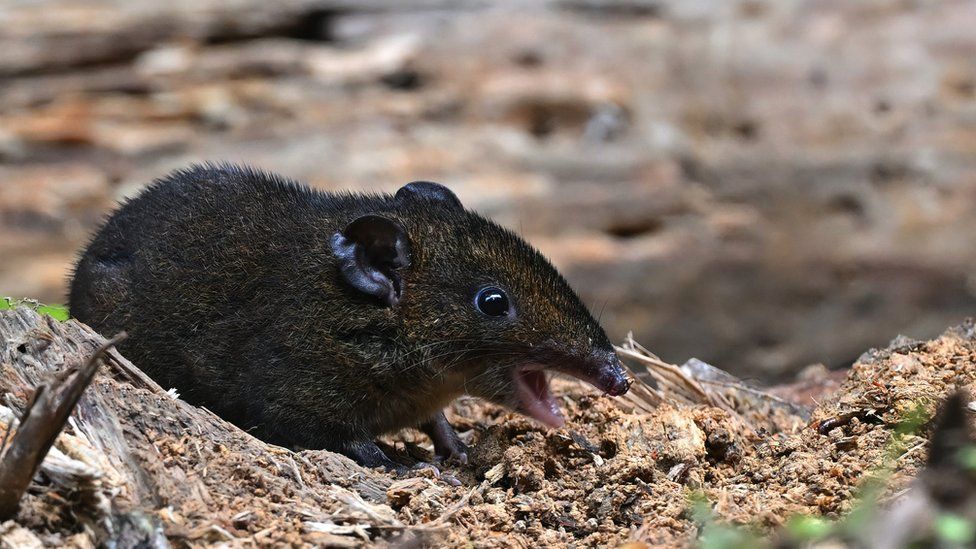
Max’s Short‑tailed Gymnure is a robust furry mammal, with body lengths around 12–16 cm, a short tail just a few centimeters long, and a weight ranging from 43 to 80 grams, making it larger than many of its relatives. Its coat is coarse and brownish on top, fading to a yellowish belly. The skull and teeth are more robust compared to closely related species, with distinctive molars and incisors reflecting its feeding adaptations.
Behavior
This species displays cathemeral activity, foraging at both day and night, and is commonly encountered alone or in small groups of two to three. Individual movement ranges are small, around 30–40 meters. They are terrestrial and move through forest litter sniffing and rootling with their long snout. Known for their elusive nature, they leave narrow runways through dense understorey.
Diet
Their diet is omnivorous and opportunistic, including insects such as beetles and crickets, earthworms, and in human-proximate areas, tapioca or bananas. Captive observations show willingness to eat fish, shrimp, or raw meat, but not much fruit. Their digestive and metabolic traits reflect adaptation to varied food sources and cooler highland microclimates.
Reproduction
A female with two embryos was observed in March, and lactating females recorded between May and November, implying a protracted or seasonal breeding cycle. Further reproductive details remain unstudied.
Communication
Though poorly documented, Max’s Short‑tailed Gymnure likely relies on scent marking and possible soft vocalizations for interaction and territorial behavior. Their keen sense of smell and tactile awareness through whiskers are important communication tools in dense forest habitats.
Threats
Max’s Short‑tailed Gymnure is not yet individually evaluated by the IUCN and remains listed under the broader “Short‑tailed Gymnure” category, which is considered Least Concern. However, its montane forest specialization makes it potentially sensitive to deforestation, habitat fragmentation, and climate change. It is present in several protected areas like Taman Negara and Kerinci Seblat.
This species as pets
There are no known records of Max’s Short‑tailed Gymnure in captivity. Its specific habitat and dietary needs, along with its elusive behavior, render it unsuitable for typical captive environments.
Where does it live?
This species inhabits hill and montane forests of southern Peninsular Malaysia and northern Sumatra, ranging from 100 to 2,000 meters elevation on Sumatra and 600 to 1,700 meters on the Malay Peninsula, with possible extensions into southern Thailand.
Linked Knowledge Hub articles
No linked public Knowledge Hub articles yet.
Linked research
No linked public research records yet.
Sources
Referenced sources
- Arlo Hinckley, Miguel Camacho-Sanchez, Marcus A H Chua, Manuel Ruedi, Darrin Lunde, Jesús E Maldonado, Hasmahzaiti Omar, Jennifer A Leonard, Melissa T R Hawkins, An integrative taxonomic revision of lesser gymnures (Eulipotyphla: Hylomys) reveals five new species and emerging patterns of local endemism in Tropical East Asia, Zoological Journal of the Linnean Society, Volume 202, Issue 2, October 2024, zlad177, https://doi.org/10.1093/zoolinnean/zlad177 Open source