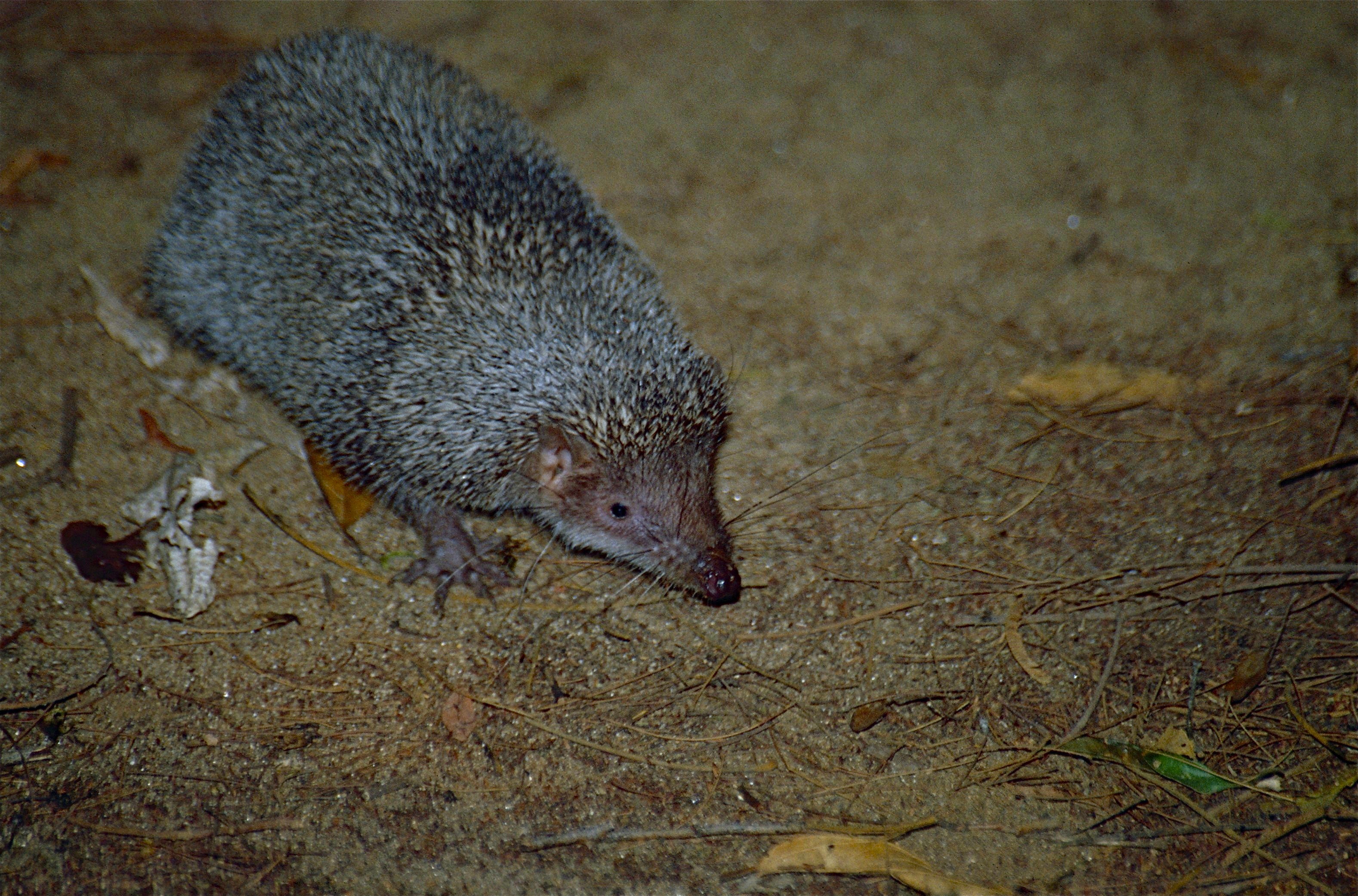
Greater hedgehog tenrec
Setifer setosus
First described in 1778 by Schreber, the Greater Hedgehog Tenrec is remarkable among its relatives as the only tenrec to possess a dense coat of sharp spines and the ability to roll into a defensive ball, traits convergent with true hedgehogs.
- NE
- DD
- LCCurrent status: Least Concern
- NT
- VU
- EN
- CR
- RE
- EW
- EX
Current status: Least Concern
What does this mean?
The assessment found a lower risk of extinction.
Categories follow the IUCN Red List.- Kingdom
- Animalia
- Phylum
- Chordata
- Class
- Mammalia
- Order
- Afrosoricida
- Suborder
- Tenrecomorpha
- Family
- Tenrecidae
- Subfamily
- Tenrecinae
- Tribe
- Setiferini
- Genus
- Setifer
- Species
- Setifer setosus
- Species group
- Tenrec
Get to know this species
Biology & ecology
Habitat
It inhabits a wide variety of habitats including dry and moist forests, savannas, shrubland, grasslands, agricultural areas, and even urban and suburban regions. It is absent only from wetlands and permanent marshes, and shows a remarkable tolerance for human disturbance.
Physical traits
This large hedgehog tenrec measures around 150 to 225 mm in body length, with a short tail of around 15–16 mm, and weighs between approximately 180 to 270 g. Its dorsal surface is covered with dense, white-tipped spines, while the underside and limbs bear soft buff or greyish fur. Its muzzle is round, eyes small, ears relatively prominent, and whiskers especially long and sensitive.
Behavior
The Greater Hedgehog Tenrec is nocturnal, solitary, and terrestrial, often sheltering in leaf-lined burrows or tree cavities during the day. It enters seasonal torpor in the dry winter months, conserving energy during prolonged inactivity. When threatened, it rolls into a tight ball with spines erect, protecting its vulnerable underparts. It is a slow, but capable climber in dense vegetation.
Diet
This tenrec is an omnivore feeding on invertebrates such as insects, earthworms, and grubs, as well as fruit, carrion and sometimes small vertebrates. It forages primarily on the ground but may climb low vegetation in search of food. Known to consume carrion opportunistically, it plays a role in nutrient cycling and seed dispersal.
Reproduction
Breeding begins after emerging from torpor in late September to mid-October and continues until April. Gestation lasts 51–65 days and litters generally consist of 1–5 young. Young are born naked and blind, weighing around 20 g; eyes open after about two weeks, and independence follows by three weeks. Both male and female may have multiple mates (polygynandrous system).
Communication
Communication behavior is not well-studied, but the species likely uses chemical signals and tactile cues during brief encounters or maternal care. Occasionally vocalizations such as grunts, squeaks, or “chirps” have been observed during mating or aggressive interactions. Males secrete a white substance from their eyes, possibly involved in territorial or sexual signaling.
Threats
The IUCN lists the Greater Hedgehog Tenrec as Least Concern, owing to its wide range, habitat adaptability, and presence across Malagasy ecosystems. Local hunts for food in some regions can impact populations, though large-scale threats are limited. Habitat modification, predation by introduced species, and climate change remain future risks.
This species as pets
Although not often kept in captivity, the Greater Hedgehog Tenrec has been studied regarding torpor, reproduction, and longevity. Captive individuals have lived up to 14 years. However, standardized husbandry protocols and captive breeding programs are rare, and its suitability for ex situ conservation remains minimally explored.
Where does it live?
The Greater Hedgehog Tenrec is endemic to Madagascar and found across nearly the entire island, ranging from sea level up to about 2,250 m elevation.
Linked Knowledge Hub articles
No linked public Knowledge Hub articles yet.
Linked research
No linked public research records yet.
Sources
Referenced sources
- Stephenson, P.J., Soarimalala, V. & Goodman, S. 2016. Setifer setosus. The IUCN Red List of Threatened Species 2016: e.T40594A97203842. https://dx.doi.org/10.2305/IUCN.UK.2016-1.RLTS.T40594A97203842.en. Accessed on 17 October 2026. Open source