
Pygmy shrew tenrec
Microgale parvula
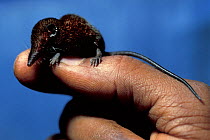
First described in 1934 by Grandidier, the Pygmy Shrew Tenrec is unique among its relatives for being one of the smallest species in the group, sometimes weighing as little as 3 grams, and possessing one of the broadest elevational ranges, spanning nearly 2,000 meters.
- NE
- DD
- LCCurrent status: Least Concern
- NT
- VU
- EN
- CR
- RE
- EW
- EX
Current status: Least Concern
What does this mean?
The assessment found a lower risk of extinction.
Categories follow the IUCN Red List.- Kingdom
- Animalia
- Phylum
- Chordata
- Class
- Mammalia
- Order
- Afrosoricida
- Suborder
- Tenrecomorpha
- Family
- Tenrecidae
- Subfamily
- Oryzorictinae
- Genus
- Microgale
- Species
- Microgale parvula
- Species group
- Tenrec
Get to know this species
Biology & ecology
Habitat
It is one of the few insectivore-like mammals with such a wide latitudinal distribution on the island. It resides exclusively in intact moist lowland and montane rainforests at elevations ranging from about 100 to nearly 1,990 m. It is rarely found in degraded or fragmented habitats, indicating a strong reliance on primary or undisturbed woodland.
Physical traits
True to its name, this tenrec is extremely small, at just 50–65 mm in head‑body length and typically weighing between 3 and 4 g, among the smallest of all shrew tenrecs. Its fur is uniformly soft and dark brown above, fading to a lighter greyish underside. The tail is nearly as long as its body. It has proportionally large ears and whiskers suited to nocturnal insect foraging.
Behavior
The Pygmy Shrew Tenrec is nocturnal, using its acute hearing and vision to hunt prey among leaf litter. It is solitary and highly metabolic, likely requiring frequent feeding through the night. While observed mostly at ground level, little is known about its exact activity rhythms, movement range, or resting habits.
Diet
As with other shrew tenrecs, this species is insectivorous, feeding on small invertebrates such as insects and larvae found in forest litter. Although no gut-content or behavioural studies have been published, its feeding ecology is inferred from its morphology and the diets of related species.
Reproduction
Very little is known. Museum specimens suggest that females may breed during the wet season, and typical shrew tenrec patterns may apply, small litters of altricial young born after a gestation of roughly two months. However, no specific data on litter size, gestation or developmental milestones have been reported.
Communication
No direct observations exist of communication behaviors in this species. It is assumed to use scent and tactile cues in brief social contexts, e.g., maternal care, similar to other relatives, but vocalisation or ultrasonic data are lacking.
Threats
It has a wide distribution and presumed large population. However, habitat loss remains a major threat since it depends on intact forest. Population trends have not been formally assessed, and continued habitat degradation could impact numbers over time.
This species as pets
There are no records of this species being kept or bred in captivity. It is absent from zoos and private collections, and no husbandry protocols have been developed, leaving captive biology unknown.
Where does it live?
The Pygmy Shrew Tenrec is endemic to Madagascar and is recorded from the southern tip to the northern peninsula.
Linked Knowledge Hub articles
No linked public Knowledge Hub articles yet.
Linked research
No linked public research records yet.
Sources
Referenced sources
- Stephenson, P.J., Soarimalala, V. & Goodman, S. 2016. Microgale parvula. The IUCN Red List of Threatened Species 2016: e.T13349A97201228. https://dx.doi.org/10.2305/IUCN.UK.2016-1.RLTS.T13349A97201228.en. Accessed on 16 October 2026. Open source