
Four-toed rice tenrec
Oryzorictes tetradactylus
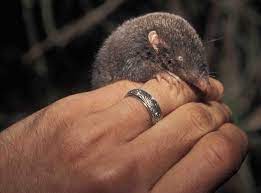
First described in 1882 by Milne‑Edwards & Grandidier, the Four‑toed Rice Tenrec is distinctive among its relatives for having only four toes on its forefeet, instead of five, which is unique within its genus.
- NE
- DDCurrent status: Data Deficient
- LC
- NT
- VU
- EN
- CR
- RE
- EW
- EX
Current status: Data Deficient
What does this mean?
There is not enough information to assess the risk.
Categories follow the IUCN Red List.- Kingdom
- Animalia
- Phylum
- Chordata
- Class
- Mammalia
- Order
- Afrosoricida
- Suborder
- Tenrecomorpha
- Family
- Tenrecidae
- Subfamily
- Oryzorictinae
- Genus
- Oryzorictes
- Species
- Oryzorictes tetradactylus
- Species group
- Tenrec
Get to know this species
Biology & ecology
Habitat
It inhabits humid montane forests, heathlands, and highland marshes at elevations between ~2,050 and 2,450 m, often above the tree line. Known mainly from museum specimens collected late 20th century, its current range and habitat preferences remain poorly documented.
Physical traits
This tenrec has a compact, muscular body around 106–122 mm in head‑body length, with a short tail of 42–49 mm, and a weight of roughly 29 to 36 g. It bears dense, soft dorsal fur in shades of brown to dark brown with lighter underparts. Its head shows a long snout with small, mostly hidden eyes and ears. Uniquely, it has only four toes on each forefoot—lacking a thumb—while the tail is bicolored and covered in coarse bristle hairs.
Behavior
Little is known behaviorally. The Four‑toed Rice Tenrec leads a semi‑fossorial and terrestrial lifestyle. It likely digs and moves under wet forest floor or marsh soils, similar to its rice tenrec relative. Beyond these morphological inferences, behavioral observations such as activity cycles, shelter use, and social patterns are entirely lacking.
Diet
Dietary information is not available for this species. Based on its morphology and habits of related rice tenrecs, it likely forages for soil- and marsh-invertebrates such as worms and insects, perhaps digging for prey with its forefeet.
Reproduction
Virtually nothing is known about reproduction. There are no published data on gestation length, litter size, breeding season, or offspring development in the wild, knowledge that remains entirely speculative and inferred only from related species.
Communication
No studies have documented vocal, tactile, or chemical communication. It is presumed to use scent marking and touch during brief interactions, similar to other tenrec relatives.
Threats
The Four‑toed Rice Tenrec is currently categorized as Data Deficient by the IUCN. Its known localities are few and based mainly on older specimen records; there is no recent information on population size, distribution extent, or ecology. Habitat degradation from agriculture, logging, and climate change may threaten populations, but without field data, threats remain speculative.
This species as pets
There are no known records of this species being kept or bred in captivity. It is absent from zoo collections and no husbandry protocols are available, so its resilience in captivity remains unknown.
Where does it live?
The Four‑toed Rice Tenrec is endemic to Madagascar’s central highlands and southeastern regions, including Andringitra National Park and areas near Antsirabe.
Linked Knowledge Hub articles
No linked public Knowledge Hub articles yet.
Linked research
No linked public research records yet.
Sources
Referenced sources
- Stephenson, P.J., Soarimalala, V. & Goodman, S. 2016. Oryzorictes tetradactylus. The IUCN Red List of Threatened Species 2016: e.T40591A97203290. https://dx.doi.org/10.2305/IUCN.UK.2016-1.RLTS.T40591A97203290.en. Accessed on 17 October 2026. Open source