
Dobson's shrew tenrec
Nesogale dobsoni
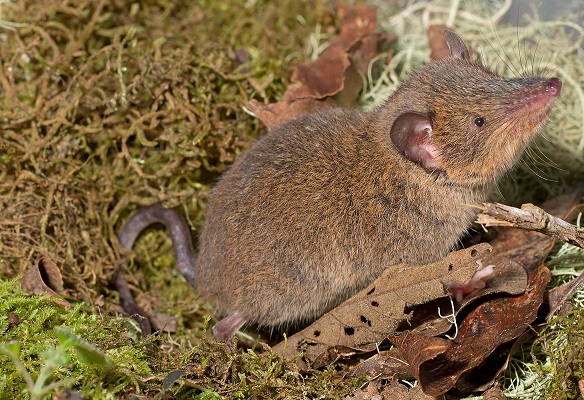
First described in 1884 by Oldfield Thomas, Dobson’s Shrew Tenrec is distinctive among its relatives for being one of the few robust, large-bodied tenrecs with pronounced seasonal fat storage in its tail, an adaptation rare among shrew tenrecs.
- NE
- DD
- LCCurrent status: Least Concern
- NT
- VU
- EN
- CR
- RE
- EW
- EX
Current status: Least Concern
What does this mean?
The assessment found a lower risk of extinction.
Categories follow the IUCN Red List.- Kingdom
- Animalia
- Phylum
- Chordata
- Class
- Mammalia
- Order
- Afrosoricida
- Suborder
- Tenrecomorpha
- Family
- Tenrecidae
- Subfamily
- Oryzorictinae
- Genus
- Microgale
- Subgenus
- Nesogale
- Species
- Nesogale dobsoni
- Species group
- Tenrec
Get to know this species
Biology & ecology
Habitat
Their habitat ranges from sea level up to approximately 2,500 m. It occupies both primary rainforest and secondary or edge habitats, including heavily degraded former forests and plantations. The species is relatively common in several protected areas but also tolerates moderate disturbance in riparian and agricultural landscapes.
Physical traits
This is one of the larger shrew tenrecs, with head–body length between 87 and 126 mm and a tail of comparable length (89–143 mm). Adults weigh between roughly 25 and 48 g. Dorsal fur ranges from gray-brown to brown with a buff wash, often with reddish tinges, while the underbelly is gray with pale buff tones. Notably, individuals accumulate fat in the tail base seasonally, and ears are long and project beyond the fur. Limbs are sturdy with buff-coloured paws.
Behavior
Dobson’s Shrew Tenrec is nocturnal and terrestrial, moving stealthily through leaf litter and along stream corridors. Its activity range often extends over 1 km per night, with individuals showing territorial and solitary behaviour. The species has been observed using rattling foot and tail movements to capture prey and may use simple echolocation to navigate dense undergrowth. Fights and aggressive interactions, especially between males, have been documented.
Diet
This species is an opportunistic insectivore that also consumes small vertebrates. It feeds on a variety of prey including orthopterans, beetles, earthworms, amphibians, and occasionally other tenrecs caught in pitfall traps, especially during the rainy season when prey is abundant.
Reproduction
Reproductive data come largely from captive studies: gestation lasts roughly 62 days, and litters range from one to five young. Births occur mostly between February and May, and young are born naked, blind and deaf. Eyes open at about 22–27 days; by around three months they are fully grown. Wild reproductive behaviour and seasonal timing are largely inferred from captive observations.
Communication
Specific studies on communication are scarce, but scent marking, tactile signals during maternal care, and territorial behaviors are likely. Occasional high-pitched squeals or trills have been observed in captive individuals during mating or aggressive encounters. Echo-based cues may also aid navigation.
Threats
Dobson’s Shrew Tenrec remains relatively common and widespread across eastern Madagascar, with tolerance to moderate habitat disturbance. However, ongoing threats include habitat fragmentation, agriculture expansion, logging, and wildfire risk. Population numbers are believed to be declining, but detailed trend data are lacking.
This species as pets
Dobson’s Shrew Tenrec has been studied in captivity, including reproductive behaviour and physiology. However, no known long-term captive populations exist today. Husbandry protocols and captive breeding remain limited to a few historical observations, reflecting a lack of standardized care guidelines.
Where does it live?
Dobson’s Shrew Tenrec inhabits the humid lowland and montane forests of eastern and central Madagascar.
Linked Knowledge Hub articles
No linked public Knowledge Hub articles yet.
Linked research
No linked public research records yet.
Sources
Referenced sources
- Stephenson, P.J., Soarimalala, V. & Goodman, S. 2016. Microgale dobsoni. The IUCN Red List of Threatened Species 2016: e.T40587A97190623. https://dx.doi.org/10.2305/IUCN.UK.2016-1.RLTS.T40587A97190623.en. Accessed on 16 October 2026. Open source