
Naked-nosed shrew tenrec
Microgale gymnorhyncha
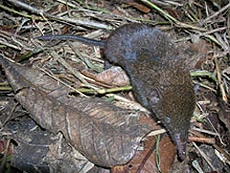
First described in 1996 by Jenkins, Goodman & Raxworthy, the Naked‑nosed shrew tenrec is unique among Microgale species for its large, bare nasal pad, a feature unseen in its relatives.
- NE
- DD
- LCCurrent status: Least Concern
- NT
- VU
- EN
- CR
- RE
- EW
- EX
Current status: Least Concern
What does this mean?
The assessment found a lower risk of extinction.
Categories follow the IUCN Red List.- Kingdom
- Animalia
- Phylum
- Chordata
- Class
- Mammalia
- Order
- Afrosoricida
- Suborder
- Tenrecomorpha
- Family
- Tenrecidae
- Subfamily
- Oryzorictinae
- Genus
- Microgale
- Species
- Microgale gymnorhyncha
- Species group
- Tenrec
Get to know this species
Biology & ecology
Habitat
It occurs in humid montane forests from roughly 970 m to 1,990 m elevation. It has been recorded in several massif regions including Andringitra, Marojejy, Ananjaharibe and Tsinjoarivo, suggesting a broad but patchy distribution. The species prefers moist habitats with soft soil, perhaps due to its fossorial habits, though detailed habitat use and tolerance to disturbance remain poorly known.
Physical traits
Naked‑nosed Shrew Tenrecs are medium-sized within the genus, measuring around 138–176 mm in total length and weighing between 13.5 and 26 g (average ≈ 16 g). They have a sleek, spindle-shaped body covered in dense dark grey fur with some brown guard hairs, a somewhat darker dorsal tail surface and lighter ventral side. Their anteater-like long snout ends in a conspicuous naked nasal pad; eyes and ears are reduced and often hidden in the pelage, and broad forefeet with strong claws suggest a digging lifestyle.
Behavior
Due to its secretive nature, little is known about the behavior of Naked‑nosed Shrew Tenrecs. It is presumed to be terrestrial and partially fossorial, foraging through leaf litter or soft soil. Its morphology suggests adaptations for digging; adults may shelter in burrows or root cavities. Activity patterns likely include bouts of foraging by night and perhaps dawn or dusk, similar to other shrew tenrecs, but no specific studies have documented its rhythms or social structure.
Diet
Although no diet-specific studies have been published, the Naked‑nosed Shrew Tenrec is presumed insectivorous, feeding on small invertebrates such as worms and insects encountered in forest litter or soil. Its dental formula (3/3 1/1 3/3 3/3 = 40 teeth) and forefeet morphology support ground-based predation, but precise dietary composition remains undocumented .
Reproduction
Reproductive biology of this species is virtually unknown. Data from related Microgale species suggest mating may occur at the onset of the rainy season (September–October), with gestation around 58–63 days and litter sizes ranging from three to eight young. However, no recorded observations or captive breeding reports exist for Naked‑nosed Shrew Tenrecs.
Communication
No targeted studies exist on vocal or chemical signalling in Naked‑nosed Shrew Tenrecs. Like other shrew tenrecs, it likely uses tactile cues and scent marking to interact with kin or mates. Occasional squeals or ultrasonic clicks, reported in related species, have not been recorded for this species, so the details of its communication remain speculative.
Threats
It has a relatively wide distribution in eastern highland forests and occurrence in multiple protected areas (e.g. Marojejy, Andringitra, Ranomafana). However, threats persist in the form of deforestation, fire and land-use change at lower elevations. Population trends remain unclear, and further ecological research is urgently needed to assess its long-term conservation status .
This species as pets
There is no known record of Naked‑nosed Shrew Tenrec being maintained or bred in captivity. No husbandry protocols, zoo holdings or private collections have documented this species, leaving its capacity to survive under human care entirely unexplored.
Where does it live?
This species is endemic to eastern Madagascar.
Linked Knowledge Hub articles
No linked public Knowledge Hub articles yet.
Linked research
No linked public research records yet.
Sources
Referenced sources
- Stephenson, P.J., Soarimalala, V. & Goodman, S. 2016. Microgale gymnorhyncha. The IUCN Red List of Threatened Species 2016: e.T62014A97191808. https://dx.doi.org/10.2305/IUCN.UK.2016-1.RLTS.T62014A97191808.en. Accessed on 15 October 2026. Open source