
Thomas' shrew tenrec
Microgale thomasi
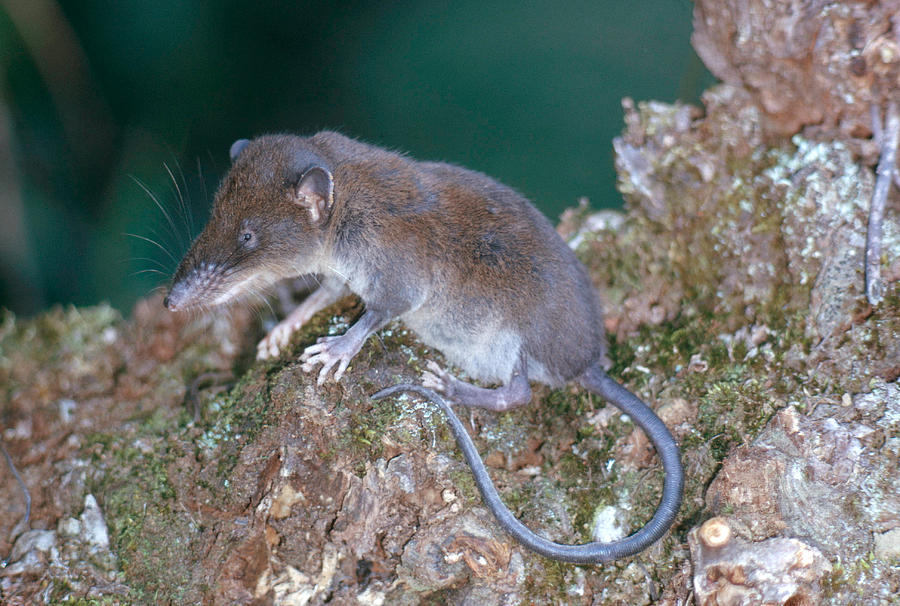
First described in 1896 by Forsyth Major, Thomas’s Shrew Tenrec is notable among its relatives for having a relatively short tail compared to body length, while being one of the larger shrew tenrec species.
- NE
- DD
- LCCurrent status: Least Concern
- NT
- VU
- EN
- CR
- RE
- EW
- EX
Current status: Least Concern
What does this mean?
The assessment found a lower risk of extinction.
Categories follow the IUCN Red List.- Kingdom
- Animalia
- Phylum
- Chordata
- Class
- Mammalia
- Order
- Afrosoricida
- Suborder
- Tenrecomorpha
- Family
- Tenrecidae
- Subfamily
- Oryzorictinae
- Genus
- Microgale
- Species
- Microgale thomasi
- Species group
- Tenrec
Get to know this species
Biology & ecology
Habitat
Thomas' shrew tenrec is inhabiting moist lowland and montane rainforests from around 600 m up to 2,000 m elevation. Its distribution includes forested areas such as the highlands around Fandriana, and it persists in some degraded landscapes near forest edges. Although relatively widespread, it is rarely encountered, and details about its exact habitat preferences or resilience to disturbance remain unknown.
Physical traits
Among its relatives, Thomas’s Shrew Tenrec is medium‑sized, with a head‑body length of about 75–112 mm, a tail of 59–80 mm (shorter than body length), and body mass ranging from 20 to 26 g. Its dense dorsal fur is dark reddish‑brown speckled with buff, fading to a lighter grey‑buff underbelly. The tail is countershaded, dark above, pale below, with coarse scale‑like hairs. It has moderate ears (15–21 mm), long foreclaws, and a long muzzle suited for probing leaf litter.
Behavior
This tenrec is terrestrial and nocturnal, sheltering under dense leaf litter or logs during daytime. Although direct observations are limited, radio‑tracking and capture data show individuals can patrol streamside forest corridors up to 1.5 km per night, occasionally feeding on other small tenrec species in pitfall traps. Social behaviour, nesting, movement patterns and thermoregulation remain almost entirely undocumented.
Diet
Thomas’s Shrew Tenrec is insectivorous and has even been observed eating smaller tenrecs in traps. Its diet probably includes insects, worms, and other small invertebrates located in forest-floor habitats. No controlled or gut-content studies have been published.
Reproduction
Reproductive biology is poorly known. Two wild-caught individuals were found with two embryos in late wet-season collection, suggesting seasonal breeding, but details such as gestation, litter size, developmental milestones, or parental care remain entirely unstudied.
Communication
There have been no studies focusing specifically on how this species communicates. It is assumed, based on comparison with its relatives, that it uses scent marking and tactile cues during brief encounters or maternal interactions. No vocalisations, clicks or ultrasonic signals have been recorded.
Threats
This species has a relatively wide distribution and occurrence in several protected forest areas such as Andringitra, Ranomafana, Mantadia and Andohahela. However, habitat loss from deforestation, mining, fire, and expansion of agriculture poses ongoing threats. Population trends are thought to be decreasing, and much remains unknown about its true conservation status in fragmented landscapes.
This species as pets
There are no known records of Thomas’s Shrew Tenrec being kept or bred in captivity. It is absent from zoos and private holdings, and no husbandry or care protocols have been developed. Its adaptability to captivity remains completely unexplored.
Where does it live?
Thomas’s Shrew Tenrec is found across eastern and central Madagascar.
Linked Knowledge Hub articles
No linked public Knowledge Hub articles yet.
Linked research
No linked public research records yet.
Sources
Referenced sources
- Stephenson, P.J., Soarimalala, V. & Goodman, S. 2016. Microgale thomasi. The IUCN Red List of Threatened Species 2016: e.T13355A97202776. https://dx.doi.org/10.2305/IUCN.UK.2016-1.RLTS.T13355A97202776.en. Accessed on 16 October 2026. Open source