
Taiva shrew tenrec
Microgale taiva
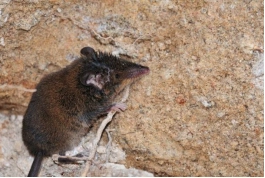
First described in 1896 by Forsyth Major, the Taiva Shrew Tenrec is unique among its relatives for occurring in both lowland and montane moist forests across discontinuous portions of eastern Madagascar, an uncommon habitat split for Microgale.
- NE
- DD
- LCCurrent status: Least Concern
- NT
- VU
- EN
- CR
- RE
- EW
- EX
Current status: Least Concern
What does this mean?
The assessment found a lower risk of extinction.
Categories follow the IUCN Red List.- Kingdom
- Animalia
- Phylum
- Chordata
- Class
- Mammalia
- Order
- Afrosoricida
- Suborder
- Tenrecomorpha
- Family
- Tenrecidae
- Subfamily
- Oryzorictinae
- Genus
- Microgale
- Species
- Microgale taiva
- Species group
- Tenrec
Get to know this species
Biology & ecology
Habitat
It occupies elevations from about 530 m up to 2,500 m, making it one of the more elevationally flexible shrew tenrecs. While most records are from intact primary forest, its presence in secondary or slightly degraded areas appears limited. Population density, microhabitat use, and tolerance to disturbance remain poorly documented.
Physical traits
Measuring approximately 71–89 mm in body length with a tail about equal in size (80–95 mm), and weighing 10–14.5 g, this tenrec has a slender spindle-shaped body, short robust limbs, and a narrow pointed muzzle. The dorsal fur is dark brown with yellowish or buff speckles, fading to greyish-buff on the underbelly. Its tail is lightly furred with pale underside and darker top, and its ears are relatively moderate in size (~15–17 mm). These features resemble those of its relative Cowan’s Shrew Tenrec, though the Taiva species is slightly larger and shows distinctive dental and skull differences.
Behavior
There is little direct behavioral information available. It is believed to be terrestrial and likely forages at night, moving stealthily through dense leaf litter or soft forest soil. Occasional captures suggest it may even climb low vegetation briefly. As with many of its relatives, nesting, home-range, and thermoregulatory patterns remain undocumented but presumed to mirror related species.
Diet
Specific dietary information is lacking, but observed feeding in related species suggests it consumes insects (beetles, grasshoppers), earthworms, and maybe amphipods, typical for forest-floor insectivores. One study using isotopic signatures found insectivorous foraging consistent with its morphology and habitat.
Reproduction
Reproductive traits are barely documented. Pregnant females have been encountered during October to December, and a single case had one embryo in each uterine horn, suggesting seasonal breeding during the rainy season. Beyond that, gestation, litter size, timing, and offspring development remain speculative and are inferred from general tenrec patterns.
Communication
No communication studies exist for this species. It likely relies on scent marking and tactile signals during brief interactions or maternal care, as seen in related shrew tenrecs. No vocalizations or ultrasonic signals have been recorded.
Threats
This species has a comparatively wide yet fragmented forest distribution and presence in several protected reserves like Mantadia, Ranomafana, Marojejy, and Andringitra. However, its population is believed to be declining due to deforestation, habitat fragmentation, and land-use change. Field research is required to clarify its true status and ecological resilience.
This species as pets
There are no known records of this species being kept or bred in captivity. It is not housed in zoos or private collections, and no husbandry or behavioral studies exist. Its response to captivity remains unknown.
Where does it live?
The Taiva Shrew Tenrec is endemic to eastern Madagascar and known from two broad but separated forest zones: lowland rainforest and higher-elevation montane rainforest, across regions like Marojejy, Mantadia, Ranomafana, and the Tsaratanana Massif.
Linked Knowledge Hub articles
No linked public Knowledge Hub articles yet.
Linked research
No linked public research records yet.
Sources
Referenced sources
- Stephenson, P.J., Soarimalala, V. & Goodman, S. 2016. Microgale taiva. The IUCN Red List of Threatened Species 2016: e.T62019A97202201. https://dx.doi.org/10.2305/IUCN.UK.2016-1.RLTS.T62019A97202201.en. Accessed on 16 October 2026. Open source