
Least shrew tenrec
Microgale pusilla
First described in 1896 by Forsyth Major, the Least Shrew Tenrec is notable among its relatives for being one of the smallest tenrec species, with head‑body lengths barely over 4.7 cm, yet it ranges across both lowland and montane forest habitats.
- NE
- DD
- LCCurrent status: Least Concern
- NT
- VU
- EN
- CR
- RE
- EW
- EX
Current status: Least Concern
What does this mean?
The assessment found a lower risk of extinction.
Categories follow the IUCN Red List.- Kingdom
- Animalia
- Phylum
- Chordata
- Class
- Mammalia
- Order
- Afrosoricida
- Suborder
- Tenrecomorpha
- Family
- Tenrecidae
- Subfamily
- Oryzorictinae
- Genus
- Microgale
- Species
- Microgale pusilla
- Species group
- Tenrec
Get to know this species
Biology & ecology
Habitat
It occupies intact and lightly disturbed moist lowland and montane forests, and has even been recorded in swampy areas, irrigated land, and pasture near forests. Its ability to persist in modified landscapes close to rice fields suggests a degree of adaptability unusual for such a tiny species.
Physical traits
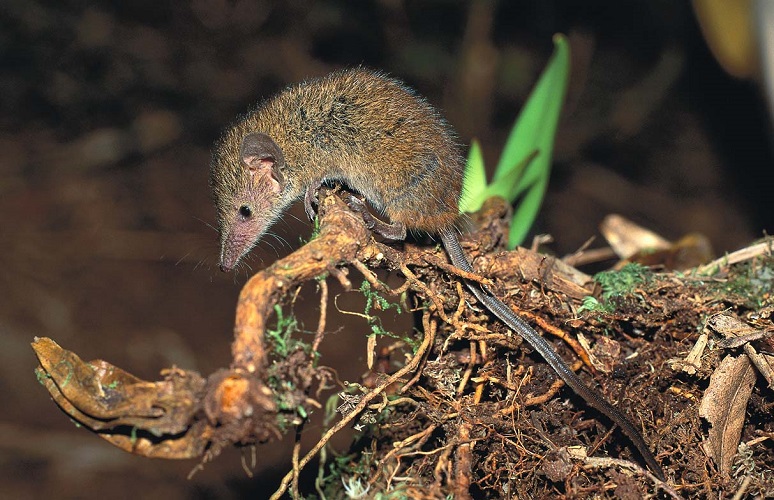
This extremely small tenrec measures just 47–56 mm in head‑body length, with a tail slightly longer, about 65–77 mm, and typically weighs between 2.5 and 4 g. Its reddish buffy-brown dorsal fur is sharply contrasted by a grey-brown underside. Small ears, delicate paws, and a slender muzzle, paired with the disproportionately long tail, reflect adaptations for life in dense leaf litter or undergrowth.
Behavior
This species forages low in the undergrowth and occasionally even on low shrubs, using its whiskered muzzle and agile tail to navigate leaf litter and soft substrates. Its behavior is mostly nocturnal, with individuals active through the night. Solitude seems typical, and no detailed activity cycles, nesting habits, or social patterns are understood beyond the assumption of rapid, ground-level movement.
Diet
Though no specific dietary studies exist, this species is presumed insectivorous, feeding on small invertebrates such as insects and larvae found in the leaf litter and soil. Its small size and high metabolic rate would require frequent foraging, similar to other shrew tenrecs.
Reproduction
Virtually nothing is known about its reproductive biology. One female was found with three embryos in January, suggesting breeding during the wet season. Gestation length, litter size, offspring development and timing remain unstudied and are inferred only from related species.
Communication
There are no direct observations of communication in this species. Like its close relations, it likely uses scent marking and tactile cues in brief interactions or maternal care, but no vocalizations, ultrasonic signals, or other communication modalities have been documented.
Threats
The Least shrew tenrec has a relatively wide distribution and presumed commonness in suitable habitat. Its ability to occupy lightly disturbed areas, including swamp margins and near rice paddies, suggests strong ecological flexibility. However, habitat loss remains a potential threat, and formal population trends are unknown.
This species as pets
No records exist of this species being kept or bred in captivity. It is not housed in zoological collections or private holdings, and there are no established husbandry protocols. Its tolerance of captivity remains entirely unexplored.
Where does it live?
The Least Shrew Tenrec is endemic to Madagascar, found across the eastern rainforest belt and central high plateaus, from about 530 to 1,670 m elevation.
Linked Knowledge Hub articles
No linked public Knowledge Hub articles yet.
Linked research
No linked public research records yet.
Sources
Referenced sources
- Stephenson, P.J., Soarimalala, V. & Goodman, S. 2016. Microgale pusilla. The IUCN Red List of Threatened Species 2016: e.T41314A97201685. https://dx.doi.org/10.2305/IUCN.UK.2016-1.RLTS.T41314A97201685.en. Accessed on 16 October 2026. Open source