
Greater long-tailed shrew tenrec
Microgale principula
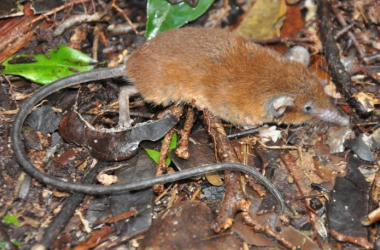
First described in 1926 by Thomas, the Greater Long‑tailed Shrew Tenrec is distinctive among its relatives for having a tail more than twice as long as its body, complete with a partially prehensile, scaled tip.
- NE
- DD
- LCCurrent status: Least Concern
- NT
- VU
- EN
- CR
- RE
- EW
- EX
Current status: Least Concern
What does this mean?
The assessment found a lower risk of extinction.
Categories follow the IUCN Red List.- Kingdom
- Animalia
- Phylum
- Chordata
- Class
- Mammalia
- Order
- Afrosoricida
- Suborder
- Tenrecomorpha
- Family
- Tenrecidae
- Subfamily
- Oryzorictinae
- Genus
- Microgale
- Species
- Microgale principula
- Species group
- Tenrec
Get to know this species
Biology & ecology
Habitat
It inhabits moist lowland and montane rainforests between approximately 440 and 1,950 m elevation, and is known to occur in both primary and lightly degraded forests. Its arboreal tendencies, inferred from morphology, suggest it may also forage above ground level in well-vegetated canopies. Despite its relatively wide and elevationally broad distribution, detailed habitat preferences and local population densities remain underdocumented.
Physical traits
Weighing about 9 to 14 g with a head–body length of 69–89 mm, this species’ tail is exceptionally long, ranging from 144 to 171 mm, often more than twice the length of its body. Its fur is reddish‑brown on the back and pale grey-buff beneath, with considerable color variation among individuals. Adaptations include elongated digits with a long fifth toe and a tail whose distal tip is covered with transverse naked scales, features that likely aid climbing and stabilization.
Behavior
Based on physical traits, the Greater Long‑tailed Shrew Tenrec is presumed to be terrestrial yet also semi-arboreal, capable of climbing and even leaping among low branches. Field behavior is practically undocumented, but its long tail and strong limbs suggest scansorial habits, climbing as well as ground movement. It is thought to be solitary and secretive, sheltering in leaf litter or dense understory vegetation.
Diet
Dietary information comes from gut-content analysis: this tenrec feeds on a variety of invertebrates including grasshoppers, beetles, ants, spiders, and aquatic amphipods, consistent with general insectivorous habits of shrew tenrecs. These prey items reflect frequent foraging in leaf litter and possibly low vegetation.
Reproduction
There are currently no data on reproductive biology. Aspects such as breeding season, gestation duration, litter size, and offspring development remain entirely undocumented. It is assumed to follow general patterns similar to related shrew tenrecs, but specifics are unknown.
Communication
There are no specific studies on how this species communicates. It likely uses scent marking and tactile cues during maternal care or agonistic interactions, similar to its relatives. No vocalizations or ultrasonic signals have been documented.
Threats
It has a wide distribution and presence within several protected areas. However, its overall population trend is suspected to be decreasing, with threats including deforestation, logging, fire, and conversion of forests to agricultural land, especially at lower elevations.
This species as pets
There is no record of this species being kept or bred in captivity. It is absent from zoo collections and private holdings, and no husbandry or care protocols are documented, its adaptability to captive conditions remains unknown.
Where does it live?
This tenrec is endemic to eastern and central Madagascar, stretching from Marojejy in the north down through southeastern forests to areas near Andohahela.
Linked Knowledge Hub articles
No linked public Knowledge Hub articles yet.
Linked research
No linked public research records yet.
Sources
Referenced sources
- Stephenson, P.J., Soarimalala, V. & Goodman, S. 2016. Microgale principula. The IUCN Red List of Threatened Species 2016: e.T13350A97201454. https://dx.doi.org/10.2305/IUCN.UK.2016-1.RLTS.T13350A97201454.en. Accessed on 16 October 2026. Open source