
Nasolo's shrew tenrec
Microgale nasoloi
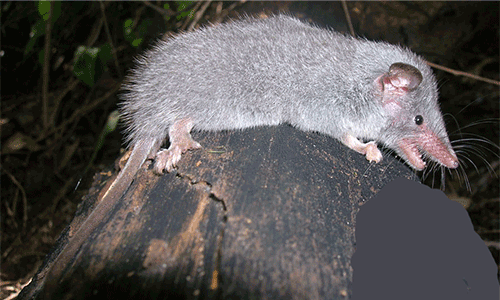
First described in 1999 by Jenkins & Goodman, Nasolo’s Shrew Tenrec is unique among its relatives for occurring in both dry deciduous and moist montane forests, habitats rarely shared within the group.
- NE
- DD
- LC
- NT
- VUCurrent status: Vulnerable
- EN
- CR
- RE
- EW
- EX
Current status: Vulnerable
What does this mean?
This species faces a high risk of extinction in the wild.
Categories follow the IUCN Red List.- Kingdom
- Animalia
- Phylum
- Chordata
- Class
- Mammalia
- Order
- Afrosoricida
- Suborder
- Tenrecomorpha
- Family
- Tenrecidae
- Subfamily
- Oryzorictinae
- Genus
- Microgale
- Species
- Microgale nasoloi
- Species group
- Tenrec
Get to know this species
Biology & ecology
Habitat
It inhabits both dry deciduous forest and pockets of moist montane forest, occupying elevations from roughly 780 m to about 1,050 m. With just four known localities, and subfossil records suggesting broader past distribution, its current range is extremely limited. Detailed information on habitat use, microhabitat preferences, or tolerance to disturbance remains scarce.
Physical traits
This is a medium-sized tenrec with a spindle-shaped body and short limbs. Its body length ranges from about 70 to 81 mm, and it has a tail slightly shorter than the body (50–62 mm); adult weight varies from approximately 5.9 to 14 g. The fur is exceptionally soft and pale grey-brown above, gradually fading to a darker underbelly. The tail is narrower than in many relatives, lightly furred and often ending with a pale tip.
Behavior
Almost nothing is known about its behavior. A few individuals have been caught at ground level or even climbing low vegetation, suggesting some scanning ability, but mostly it is considered terrestrial. It was recorded during the rainy season inside a single snag perched about 1.5 m above ground, hinting at flexibility in shelter options. Home‑range use, activity rhythms, nesting, and social habits have not been documented.
Diet
There are no direct studies on dietary habits. One captured female was found with beetle shells and roach remains in the trap. Based on morphology and diet of related species, it likely forages for insects and worms in leaf litter. Exact dietary composition and seasonality are unknown.
Reproduction
Reproductive biology is essentially undocumented. One captured female in January carried three embryos, suggesting breeding during the wet season. No data exist on gestation length, litter frequency, or juvenile development, and conclusions are drawn only by analogy with related tenrecs.
Communication
Communication has never been studied in Nasolo’s Shrew Tenrec. Like its relatives, it likely relies on scent marking and tactile cues during mother-offspring interactions or brief encounters, but no vocalizations or chemical signals are documented.
Threats
Nasolo’s Shrew Tenrec is listed as Vulnerable by the IUCN due to its extremely restricted distribution (only four known localities) and ongoing habitat loss through woody biomass harvesting, cattle grazing, and fire in southwestern Madagascar. Although some of its remaining forest lies within protected zones like Zombitse‑Vohibasia and Analavelona, population trends are unknown and significant knowledge gaps limit conservation planning.
This species as pets
There are no records indicating this species has ever been kept or bred in captivity. No zoo collections or private institutions include it, and no husbandry or captive-care information exists, leaving its captive response entirely unknown.
Where does it live?
Nasolo’s Shrew Tenrec is endemic to southwestern Madagascar, known only from a handful of forest patches in regions such as Vohibasia and Analavelona.
Linked Knowledge Hub articles
No linked public Knowledge Hub articles yet.
Linked research
No linked public research records yet.
Sources
Referenced sources
- Stephenson, P.J., Soarimalala, V. & Goodman, S. 2016. Microgale nasoloi. The IUCN Red List of Threatened Species 2016: e.T62017A97200965. https://dx.doi.org/10.2305/IUCN.UK.2016-1.RLTS.T62017A97200965.en. Accessed on 16 October 2026. Open source