
Montane shrew tenrec
Microgale monticola
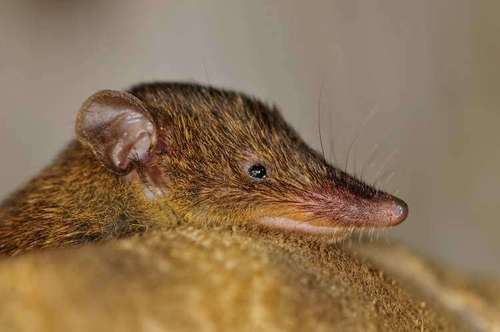
First described in 1998 by Goodman & Jenkins, this montane shrew tenrec is distinctive among its relatives for being confined strictly to high-elevation mossy forests at over 1,500 m in two isolated mountain massifs in northern Madagascar.
- NE
- DD
- LC
- NT
- VUCurrent status: Vulnerable
- EN
- CR
- RE
- EW
- EX
Current status: Vulnerable
What does this mean?
This species faces a high risk of extinction in the wild.
Categories follow the IUCN Red List.- Kingdom
- Animalia
- Phylum
- Chordata
- Class
- Mammalia
- Order
- Afrosoricida
- Suborder
- Tenrecomorpha
- Family
- Tenrecidae
- Subfamily
- Oryzorictinae
- Genus
- Microgale
- Species
- Microgale monticola
- Species group
- Tenrec
Get to know this species
Biology & ecology
Habitat
It inhabits moist evergreen montane forests at elevations between roughly 1,550 and 1,950 m, including bamboo-dominated slopes and veiled valleys. Distribution is highly restricted, with only four known localities within a narrow elevational band. Habitat destruction such as illegal logging, firewood harvesting and gem mining threatens even the protected forest areas where it is found.
Physical traits
This species is medium-sized for a shrew tenrec, with a head–body length of about 81–92 mm and a tail of 105–113 mm, making the tail longer than the body. Individuals typically weigh around 15.5 g (range 13.5–17.5 g). Fur is dark brown mixed with grey on the upper side, with underparts showing a silver‑grey or buff wash, and tails often ending in a white tip. Large ears, long claws on forepaws, and strong limbs suggest a ground-dwelling forager in soft montane litter.
Behavior
Almost nothing is known about its natural behavior. It is presumed to be terrestrial and secretive, foraging within leaf litter or soft soil. Like many shrew tenrecs, it likely remains active at dawn, dusk or night, and shelters in hidden forest-floor retreats. No detailed observations exist on its activity pattern, social interactions, nesting, or locomotion.
Diet
There is no direct dietary data for the Montane Shrew Tenrec. Given its morphology and forest-floor habitat, it almost certainly feeds on soil invertebrates such as insects and worms. No gut-content or behavioural studies have been published.
Reproduction
Reproductive biology remains unknown: no documentation exists regarding breeding season, litter size, gestation length, or offspring development. Museum evidence suggests seasonal reproduction, but all reproductive traits are inferred from patterns in related shrew tenrecs.
Communication
No specific studies document vocal or chemical communication in this species. It is assumed, as with its relatives, that scent marking and tactile signals are used during brief social interactions or maternal care. Vocalisations have not been observed.
Threats
It has a very limited range (just four sites), narrow elevational zone, and ongoing habitat threats like illegal logging, firewood harvesting, and gemstone mining, even within protected reserves. Its vulnerability is amplified by climate change and land-use pressures. Urgent field research and stronger habitat protection are essential.
This species as pets
There are no known records of the Montane Shrew Tenrec being kept or bred in captivity. It is absent from zoo collections or private holdings, and no husbandry or captive care protocols have been developed. Its adaptability to captivity remains unknown.
Where does it live?
The Montane Shrew Tenrec occurs only in two mountain ranges in northern Madagascar, the Marojejy and Anjanaharibe‑Sud massifs.
Linked Knowledge Hub articles
No linked public Knowledge Hub articles yet.
Linked research
No linked public research records yet.
Sources
Referenced sources
- Stephenson, P.J., Soarimalala, V. & Goodman, S. 2016. Microgale monticola. The IUCN Red List of Threatened Species 2016: e.T29462A97200712. https://dx.doi.org/10.2305/IUCN.UK.2016-1.RLTS.T29462A97200712.en. Accessed on 16 October 2026. Open source