
Web-footed tenrec
Microgale mergulus
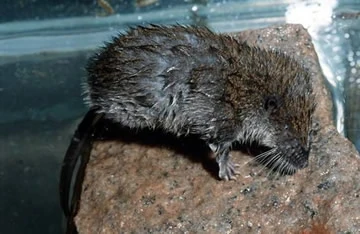
First described in 1896 by Forsyth Major, the Web‑footed Tenrec is unique among its relatives as the only semi‑aquatic tenrec, with webbed feet and water-repellent fur enabling it to hunt in flowing streams.
- NE
- DD
- LC
- NT
- VUCurrent status: Vulnerable
- EN
- CR
- RE
- EW
- EX
Current status: Vulnerable
What does this mean?
This species faces a high risk of extinction in the wild.
Categories follow the IUCN Red List.- Kingdom
- Animalia
- Phylum
- Chordata
- Class
- Mammalia
- Order
- Afrosoricida
- Suborder
- Tenrecomorpha
- Family
- Tenrecidae
- Subfamily
- Oryzorictinae
- Genus
- Microgale
- Species
- Microgale mergulus
- Species group
- Tenrec
Get to know this species
Biology & ecology
Habitat
It is strictly associated with riparian habitats and freshwater streams, where it spends its life mostly within water or on stream banks. Although rainforest-dependant, it can tolerate nearby cleared or partially disturbed areas as long as riparian zones remain intact.
Physical traits
The Web‑footed Tenrec is the largest member of the shrew-tenrec group, reaching 25–39 cm in total length and weighing between 40 and 60 g. It has a sleek, spindle-shaped body suited to swimming, dense water-resistive fur, a keeled tail for propulsion, and webbed hindfeet fringed with stiff hairs. Its nasal vibrissae and muzzle are sensitive for detecting prey underwater, and it is countershaded, dark above, pale below, to camouflage in aquatic environments.
Behavior
Strictly nocturnal and solitary, this tenrec spends the day in streamside burrows and emerges at night to forage along water channels. Radio tracking shows individuals patrol stream stretches of up to 1.5 km in one night. While swimming, it dives for 10–15 seconds at a time and hunts prey underwater using its whiskers to sense movement.
Diet
The diet consists mainly of aquatic insects and larvae (especially mayflies, dragonflies, caddisflies), along with small crustaceans such as crayfish and occasionally small fish or tadpoles. Captive observations reveal that individuals dive, seize prey underwater, then surface and roll onto their backs to dismember prey using their hindfeet.
Reproduction
Virtually nothing is known about the reproductive biology of this species. There are no published records regarding gestation, breeding season, litter size, or developmental milestones. Most information about its life cycle remains completely undocumented.
Communication
No direct studies on its communication exist. However, like other tenrec relatives, it likely relies on scent marking and tactile cues during social interactions, especially maternal care or territorial marking. Vocalizations have not been documented in this species, but soft squeals may occur at close range.
Threats
It lives in a highly restricted habitat (less than ~2,000 km² of suitable stream habitat), ongoing loss of riparian forest, stream degradation, and sedimentation. Although it persists in some disturbed areas, it is v
This species as pets
There are no records of this species being kept or bred in captivity. No zoos or private collections report holding it, and no husbandry protocols exist. Its capacity to survive in captive conditions remains entirely unknown.
Where does it live?
This species is found only in eastern Madagascar, especially around fast-flowing mountain streams such as those in Ranomafana and Andringitra National Parks.
Linked Knowledge Hub articles
No linked public Knowledge Hub articles yet.
Linked research
No linked public research records yet.
Sources
Referenced sources
- Stephenson, P.J., Soarimalala, V. & Goodman, S. 2016. Limnogale mergulus. The IUCN Red List of Threatened Species 2016: e.T11979A97189690. https://dx.doi.org/10.2305/IUCN.UK.2016-1.RLTS.T11979A97189690.en. Accessed on 16 October 2026. Open source