
Northern shrew tenrec
Microgale jobihely
First described in 2006 by Goodman, Raxworthy, Maminirina & Olson, the Northern Shrew Tenrec is especially notable for its extremely restricted, disjunct range, known only from two small populations nearly 500 km apart in Madagascar.
- NE
- DD
- LC
- NT
- VU
- ENCurrent status: Endangered
- CR
- RE
- EW
- EX
Current status: Endangered
What does this mean?
This species faces a very high risk of extinction in the wild.
Categories follow the IUCN Red List.- Kingdom
- Animalia
- Phylum
- Chordata
- Class
- Mammalia
- Order
- Afrosoricida
- Suborder
- Tenrecomorpha
- Family
- Tenrecidae
- Subfamily
- Oryzorictinae
- Genus
- Microgale
- Species
- Microgale jobihely
- Species group
- Tenrec
Get to know this species
Biology & ecology
Habitat
Its distribution is highly limited, occupying only about 282 km², and both sites suffer from human pressures such as mining, logging and agricultural clearing. Detailed studies on its habitat tolerance or adaptability to disturbance are still lacking.
Physical traits
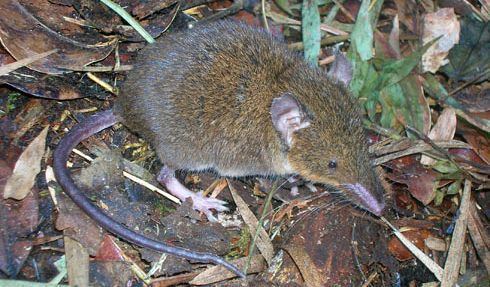
This forest-dwelling tenrec is small, with a head-body length between about 53 and 80 mm and a tail measuring 60–90% of that length (44–57 mm); it typically weighs between 7 and 10 g. Its soft, dense dorsal fur is dark reddish-brown to nearly black, blending into a paler underbelly. It has broad forefeet adapted for ground movement, small ears, and a pointed muzzle. These general proportions resemble those of its relatives, but it’s distinguished by subtle cranial and dental characters uncovered in morphometric studies.
Behavior
Observations of its natural behavior are rare. It is presumed to be terrestrial and secretive, sheltering in leaf litter or within soft soil. Individuals are known only from pitfall traps in montane sites, suggesting ground-level activity. Seasonal patterns of activity, nocturnal versus diurnal, and social behaviour have not been documented, though its closely related species Cowan’s Shrew Tenrec offers a behavioral template.
Diet
Specific dietary studies are not available for this species. Based on morphology and the diets of similar shrew tenrecs, it likely feeds on small invertebrates such as insects and worms encountered in forest litter. No gut-content or isotopic data exist to verify this assumption.
Reproduction
Reproductive biology remains entirely unknown. Since its description in 2006, no female with embryos or juveniles has been reported, and key reproductive parameters, gestation length, litter size, breeding season, and juvenile development, are unstudied. General tenrec patterns suggest altricial young born once per rainy season, but actual details remain undocumented.
Communication
There is no direct information on how this species communicates. Like its relatives, it probably relies on scent marking and tactile signals in brief interactions or maternal care, but no vocalisations or chemical cues have been recorded.
Threats
This species is endangered due to its extremely limited and fragmented distribution, small area of occupancy (~282 km²), and ongoing threats from deforestation, mining and agricultural expansion. Neither known population is within formally protected national parks, which amplifies the need for habitat preservation and ecological monitoring.
This species as pets
There are no known records of this species kept or bred in captivity. It has not been documented in zoos or private collections, and no husbandry protocols exist, leaving its tolerance to captive conditions entirely unknown.
Where does it live?
The Northern Shrew Tenrec is endemic to Madagascar and known only from two widely separated montane forest locales. One population inhabits the southwestern slopes of the Tsaratanana Massif at elevations between approximately 1,420 and 1,680 m; a second population exists in central-eastern Ambatovy forest.
Linked Knowledge Hub articles
No linked public Knowledge Hub articles yet.
Linked research
No linked public research records yet.
Sources
Referenced sources
- Stephenson, P.J., Soarimalala, V. & Goodman, S. 2016. Microgale jobihely. The IUCN Red List of Threatened Species 2016: e.T136628A21282528. https://dx.doi.org/10.2305/IUCN.UK.2016-1.RLTS.T136628A21282528.en. Accessed on 16 October 2026. Open source