
Jenkins' shrew tenrec
Microgale jenkinsae
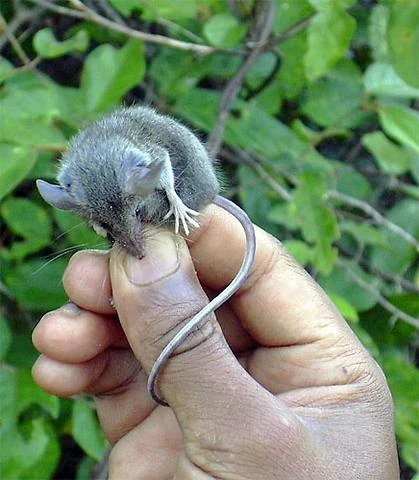
First described in 2004 by Goodman & Soarimalala, Jenkins’s Shrew Tenrec is unique among its relatives for having a tail that is noticeably longer than its body.
- NE
- DD
- LC
- NT
- VU
- ENCurrent status: Endangered
- CR
- RE
- EW
- EX
Current status: Endangered
What does this mean?
This species faces a very high risk of extinction in the wild.
Categories follow the IUCN Red List.- Kingdom
- Animalia
- Phylum
- Chordata
- Class
- Mammalia
- Order
- Afrosoricida
- Suborder
- Tenrecomorpha
- Family
- Tenrecidae
- Subfamily
- Oryzorictinae
- Genus
- Microgale
- Species
- Microgale jenkinsae
- Species group
- Tenrec
Get to know this species
Biology & ecology
Habitat
It inhabits sandy soil woodlands where rainfall ranges from about 350 to 750 mm annually, with a short canopy dominated by dry vegetation species. Its known range is extremely limited, estimated at around 1.6 km², and subsequent surveys in similar habitats have not yet recorded additional individuals.
Physical traits
This tiny mammal measures only about 143–147 mm in total length, the tail alone accounting for 71–81 mm, making it longer than the body itself. Individuals weigh between roughly 5 and 5.5 g. Its fur is dense and tannish-brown with darker flecks, giving an agouti appearance, while the underside is paler and slate-grey. The tail is dark above and much lighter below. Overall, its proportions and fur pattern distinguish it from other shrew tenrecs.
Behavior
Almost nothing is known about the behavior of Jenkins’s Shrew Tenrec due to its rarity. It is presumed to be terrestrial and ground-dwelling, likely moving silently through leaf litter or shallow sandy soils. The two known individuals were caught during the rainy season and were not fully grown, suggesting reproductive activity may align with wetter months. Social behavior, activity rhythm, nesting or burrowing habits remain undocumented.
Diet
Because no dietary studies exist, diet can only be inferred from related species and morphology: insectivorous prey such as worms and small arthropods found in the leaf litter or soil are likely. Its small size and high metabolism suggest frequent foraging, though no direct evidence confirms this.
Reproduction
Virtually nothing is known about its reproduction. At the time of capture, the two individuals were juvenile or sub‑adult. Litter size, gestation, seasonal timing and development remain entirely speculative, though reproduction during the rainy season seems plausible given the context of collection.
Communication
No specific observations exist regarding communication. It is likely that, as with other shrew tenrecs, it uses scent marking and possibly tactile cues in brief social interactions, but no vocalizations or chemical signalling have been recorded.
Threats
This species is classified as Endangered by the IUCN due to its extremely limited known range (less than ~2,000 km²), occurrence at only one site, and ongoing habitat loss in the Mikea Forest region. Forest clearance for agriculture, bushfires and vegetation degradation are key threats. Although the Mikea Forest is in the process of becoming a protected area, urgent research and habitat monitoring are needed to assess its true status and potential adaptability to disturbance.
This species as pets
There are no records of Jenkins’s Shrew Tenrec ever being kept or bred in captivity. No zoo collections or private institutions report holding this species, and no husbandry information exists.
Where does it live?
Jenkins’s Shrew Tenrec is known only from very dry forest and shrubland in the Mikea Forest of southwestern Madagascar, in a small area approximately between Morombe and Manombo River.
Linked Knowledge Hub articles
No linked public Knowledge Hub articles yet.
Linked research
No linked public research records yet.
Sources
Referenced sources
- Stephenson, P.J., Soarimalala, V. & Goodman, S. 2016. Microgale jenkinsae. The IUCN Red List of Threatened Species 2016: e.T62015A97192062. https://dx.doi.org/10.2305/IUCN.UK.2016-1.RLTS.T62015A97192062.en. Accessed on 16 October 2026. Open source