
Pale shrew tenrec
Microgale fotsifotsy
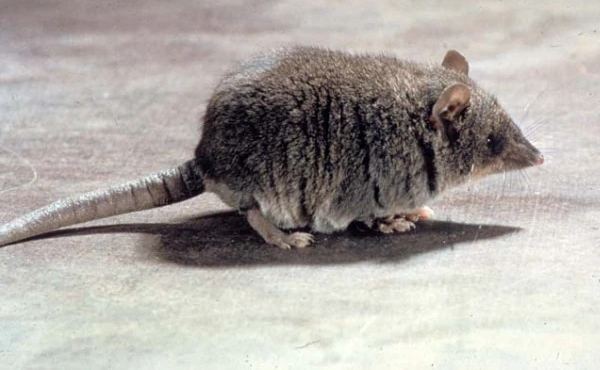
First described in 1997 by Jenkins, Raxworthy & Nussbaum, the Pale Shrew Tenrec is notable among Microgale species for its pale-colored limbs and particularly long tail nearly equal to its body length.
- NE
- DD
- LCCurrent status: Least Concern
- NT
- VU
- EN
- CR
- RE
- EW
- EX
Current status: Least Concern
What does this mean?
The assessment found a lower risk of extinction.
Categories follow the IUCN Red List.- Kingdom
- Animalia
- Phylum
- Chordata
- Class
- Mammalia
- Order
- Afrosoricida
- Suborder
- Tenrecomorpha
- Family
- Tenrecidae
- Subfamily
- Oryzorictinae
- Genus
- Microgale
- Species
- Microgale fotsifotsy
- Species group
- Tenrec
Get to know this species
Biology & ecology
Habitat
It inhabits moist lowland and montane forests, typically between 600 and 2,500 m elevation and occasionally in transitional humid-dry zones. Though relatively widespread and present in several protected areas, detailed data on its habitat preferences and habitat tolerance remain limited.
Physical traits
This small tenrec measures approximately 59–81 mm in head–body length, with a tail of 69–94 mm, so its tail is nearly as long as its body. It weighs around 7–15 g. Its dorsal fur is soft and pale grizzled yellowish‑brown to gray, with a light gray or buff underbelly, often tinged with reddish tones. The tail is distinctly two‑toned, darker above, pale buff below, with a lighter tip and often a thin white pencil of hairs. Feet are brown with pale digits, and the ears are relatively prominent and pale. The elongated fifth toe on the hindfoot nearly matches the length of the second toe.
Behavior
Very little is known about the behavior of the Pale Shrew Tenrec. It appears to be terrestrial and primarily active on the ground within leaf litter, although specific diel activity patterns (diurnal versus nocturnal) are not well documented. It likely forages frequently due to its small size and high metabolism; however, details about home range, resting or nesting behavior, and social structure are lacking.
Diet
While no targeted dietary studies have been conducted, captive or incidental observations suggest it feeds on insects such as orthopterans and coleopterans. These ground-dwelling invertebrates align with the typical insectivorous diet of similarly sized tenrecs, though seasonal or habitat-specific preferences are not known.
Reproduction
Reproductive biology of M. fotsifotsy is barely documented. A few wild-caught females have been found with three to four embryos, but data on gestation length, birth seasonality, litter size or developmental rates are lacking. It is assumed that young are born altricial and develop similarly to related shrew tenrecs, but specifics are not available.
Communication
No direct studies exist on communication for this species. As with many Microgale, it presumably uses chemical cues and physical contact during mother–offspring interactions and possibly low-volume vocalizations or squeals, but none have been specifically recorded for this species.
Threats
It is presumed to have a relatively wide distribution and large population. While present in some protected forests, its range is affected by deforestation, habitat fragmentation, and cattle grazing, especially at lower elevations, as well as fire. Population trends are unknown, and further surveys are needed to assess its resilience and conservation outlook.
This species as pets
There are no records of captive maintenance or breeding of the Pale Shrew Tenrec. Its care needs, husbandry protocols, or potential for ex situ conservation remain entirely unexplored.
Where does it live?
The Pale Shrew Tenrec is endemic to Madagascar, distributed across northern, eastern, and southeastern regions.
Linked Knowledge Hub articles
No linked public Knowledge Hub articles yet.
Linked research
No linked public research records yet.
Sources
Referenced sources
- Stephenson, P.J., Soarimalala, V. & Goodman, S. 2016. Microgale fotsifotsy. The IUCN Red List of Threatened Species 2016: e.T62013A97191387. https://dx.doi.org/10.2305/IUCN.UK.2016-1.RLTS.T62013A97191387.en. Accessed on 15 October 2026. Open source