
Dryad shrew tenrec
Microgale dryas
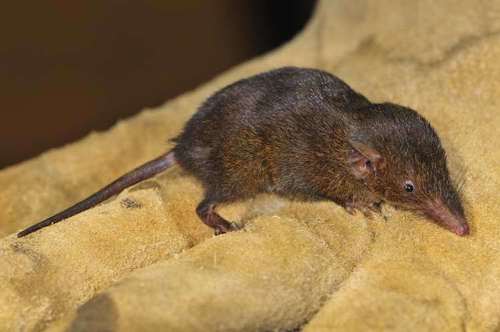
First described in 1992 by Jenkins, the Dryad Shrew Tenrec is unique among its relatives for its flattened quills along the dorsal hairs, a rare feature in the genus that gives it a distinctive appearance.
- NE
- DD
- LC
- NT
- VUCurrent status: Vulnerable
- EN
- CR
- RE
- EW
- EX
Current status: Vulnerable
What does this mean?
This species faces a high risk of extinction in the wild.
Categories follow the IUCN Red List.- Kingdom
- Animalia
- Phylum
- Chordata
- Class
- Mammalia
- Order
- Afrosoricida
- Suborder
- Tenrecomorpha
- Family
- Tenrecidae
- Subfamily
- Oryzorictinae
- Genus
- Microgale
- Species
- Microgale dryas
- Species group
- Tenrec
Get to know this species
Biology & ecology
Habitat
Known only from a few scattered populations in lowland and mid‑elevation rainforest between approximately 600 and 750 m above sea level, especially around Ambatovaky Special Reserve. Because it has only been recorded in a handful of localities within primary forest, its distribution appears extremely limited, and habitat specialists suspect it may occur in other nearby protected forests. Its rarity makes it difficult to assess habitat flexibility.
Physical traits
A small, slender insectivore, the Dryad Shrew Tenrec measures about 170 to 180 mm in total length (including tail) but weighs only around 40 g, a relatively heavier build among shrew‑tenrecs. Its body is spindle-shaped with short limbs, soft dense fur, and a comparatively short tail. The most notable trait is the presence of flattened shafts on its dorsal guard hairs, creating a somewhat bristled appearance not seen in most other Microgale.
Behavior
Almost nothing is known about Dryad Shrew Tenrec behavior because the species is rarely encountered in the wild. It is presumed to be terrestrial and secretive, sheltering in dense leaf litter or under logs. Based on the habits of related Microgale species, it likely forages at irregular times during day or night, remains solitary, and may build simple nests for its young. Quantitative data on home range, activity rhythms, or thermoregulation are currently lacking.
Diet
While no dietary studies exist specifically for the Dryad Shrew Tenrec, its structure and comparisons with congeners suggest it feeds on small invertebrates, earthworms, insects and other ground-dwelling prey. This assumption aligns with observations of captive individuals in the genus favoring grasshoppers and worms. Precise diet composition in the wild remains unstudied.
Reproduction
Breeding presumably coincides with Madagascar’s rainy season beginning in September, and gestation typically lasts two to four months in related species, yielding one to four young per litter. Young are likely born altricial and weaned in about a month. However, any data specific to Dryad Shrew Tenrecs, including litter frequency, timing, or parental behavior, appear entirely absent from scientific literature.
Communication
No direct observations have been made of vocal or chemical communication in Dryad Shrew Tenrecs. Like other shrew tenrecs, it probably uses scent marking and tactile cues, especially during mother–offspring care. Occasional high‑pitched squealing observed in related species may occur here, but confirmation is absent.
Threats
Due to its very limited known range and the ongoing loss of lowland rainforest in northeastern Madagascar, the species is deemed very vulnerable. It has only ever been documented in a small number of sites, and large-scale deforestation for agriculture, logging and development seriously threaten its habitat. Several reserves, including Ambatovaky and Anjanaharibe‑Sud, provide some protection, but much remains unknown about its true distribution and population size.
This species as pets
Dryad shrew tenrec is not known to have ever been kept in captivity. There are no records of any individuals being housed in zoos or private collections, and no studies exist regarding the care or reproduction of the species. Consequently, it is unknown to what extent the animal can thrive in captivity, or whether there are possibilities for its conservation outside of its natural habitat (ex-situ conservation).
Where does it live?
The Dryad Shrew Tenrec is endemic to northeastern Madagascar.
Linked Knowledge Hub articles
No linked public Knowledge Hub articles yet.
Linked research
No linked public research records yet.
Sources
Referenced sources
- Stephenson, P.J., Soarimalala, V. & Goodman, S. 2016. Microgale dryas. The IUCN Red List of Threatened Species 2016: e.T13356A97191108. https://dx.doi.org/10.2305/IUCN.UK.2016-1.RLTS.T13356A97191108.en. Accessed on 15 October 2026. Open source