
Drouhard's shrew tenrec
Microgale drouhardi
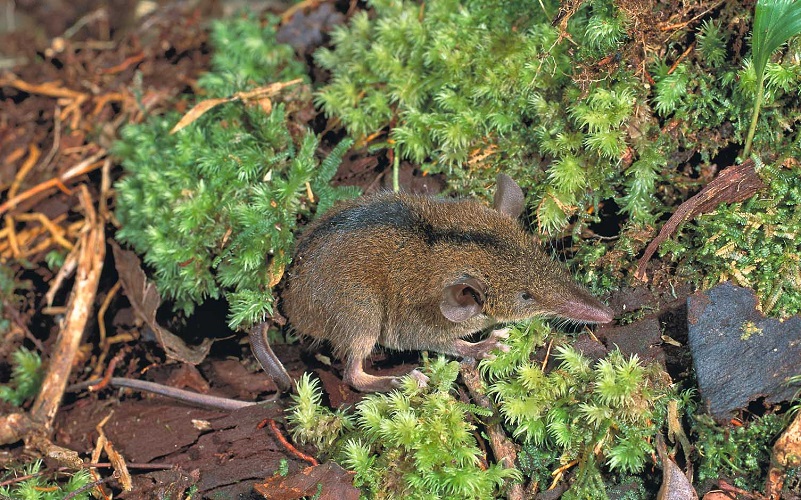
First described in 1934 by Grandidier, Drouhard’s Shrew Tenrec is unique among shrew tenrecs for its characteristic dorsal stripe, a feature not shared by other’s in its family.
- NE
- DD
- LCCurrent status: Least Concern
- NT
- VU
- EN
- CR
- RE
- EW
- EX
Current status: Least Concern
What does this mean?
The assessment found a lower risk of extinction.
Categories follow the IUCN Red List.- Kingdom
- Animalia
- Phylum
- Chordata
- Class
- Mammalia
- Order
- Afrosoricida
- Suborder
- Tenrecomorpha
- Family
- Tenrecidae
- Subfamily
- Oryzorictinae
- Genus
- Microgale
- Species
- Microgale drouhardi
- Species group
- Tenrec
Get to know this species
Biology & ecology
Habitat
It has been documented in a variety of humid forest types, including areas near forest edges and marshland close to agricultural zones, suggesting a tolerance of some habitat disturbance. However, fine‑scale habitat preferences and population density remain poorly studied, leaving important gaps in our understanding of its ecology.
Physical traits
This medium-sized Microgale has a spindle-shaped body with head‑body length ranging between about 6.3 and 8.3 cm, and a tail of similar length; adult weights recorded around 9–11 g. Its soft, dense coat is typically dark brown with a distinct mid‑dorsal stripe running from head to tail, a feature that earned it the common name “striped shrew tenrec.” Fur colouration varies geographically, with some northern populations showing darker hues and those from central or southern regions appearing more reddish or grey‑brown. Ears are moderate in size (around 12–17 mm), and limbs are short but sturdy, well adapted for ground movement in dense leaf litter.
Behavior
Very little is known about the daily behaviour of Drouhard’s Shrew Tenrec. It appears to be terrestrial and secretive, typically sheltering within dense leaf litter or under logs. Occasionally individuals have been observed in human-made pitfall traps during surveys, implying ground-level activity rather than arboreal habits. One interesting note is that captive individuals preferred grasshoppers and worms, suggesting a diet typical of ground-foraging insectivores. Unlike some other Microgale species, it may maintain a relatively stable body temperature and high standard metabolic rate, though behavioural details remain speculative.
Diet
Dietary data for Drouhard’s Shrew Tenrec are limited, but it is likely insectivorous, feeding on grasshoppers, earthworms and other small invertebrates found on the forest floor. Gut or isotopic studies are absent, but its morphology and some captive evidence align with a generalist ground-foraging lifestyle similar to its congeners.
Reproduction
There is essentially no published information on the reproductive biology of this species. The only reproductive insights come from museum specimens and incidental captures, with no data on litter size, gestation, seasonality or developmental milestones. It is safe to assume, based on relative species, that young are born altricial, blind and hairless, and weaned after a few weeks, but the specifics remain unknown.
Communication
There are no detailed studies on vocal or chemical communication in this species. It likely uses scent marking and tactile cues during mother–offspring care or brief interactions during the breeding season, similar to closely related species. Occasional high‑pitched squeals have been reported in other Microgale species and may occur in this one too, but direct observations are lacking.
Threats
It occurs in several protected areas including Masoala Peninsula, Montagne d’Ambre and Zahamena National Parks, which help buffer effects of deforestation. Nonetheless, habitat loss in lower elevations due to woodland clearance for agriculture or wood extraction poses a potential threat, particularly in unprotected zones. More field surveys and studies are needed to accurately assess its ecological resilience and population trends.
This species as pets
There are no records of sustained captive populations or husbandry protocols for Drouhard’s Shrew Tenrec. Very limited observations suggest it may accept grasshoppers or worms, but no captive breeding or care studies have been published. As with many rare Microgale species, its maintenance under human care remains wholly untested.
Where does it live?
Drouhard’s Shrew Tenrec is endemic to eastern Madagascar, where it occupies a remarkably wide altitudinal range, from lowland to montane moist forests spanning roughly 350 to 2,350 m above sea level.
Linked Knowledge Hub articles
No linked public Knowledge Hub articles yet.
Linked research
No linked public research records yet.
Sources
Referenced sources
- Stephenson, P.J., Soarimalala, V. & Goodman, S. 2016. Microgale drouhardi. The IUCN Red List of Threatened Species 2016: e.T62012A97190851. https://dx.doi.org/10.2305/IUCN.UK.2016-1.RLTS.T62012A97190851.en. Accessed on 15 October 2026. Open source