
Cowan's shrew tenrec
Microgale cowani
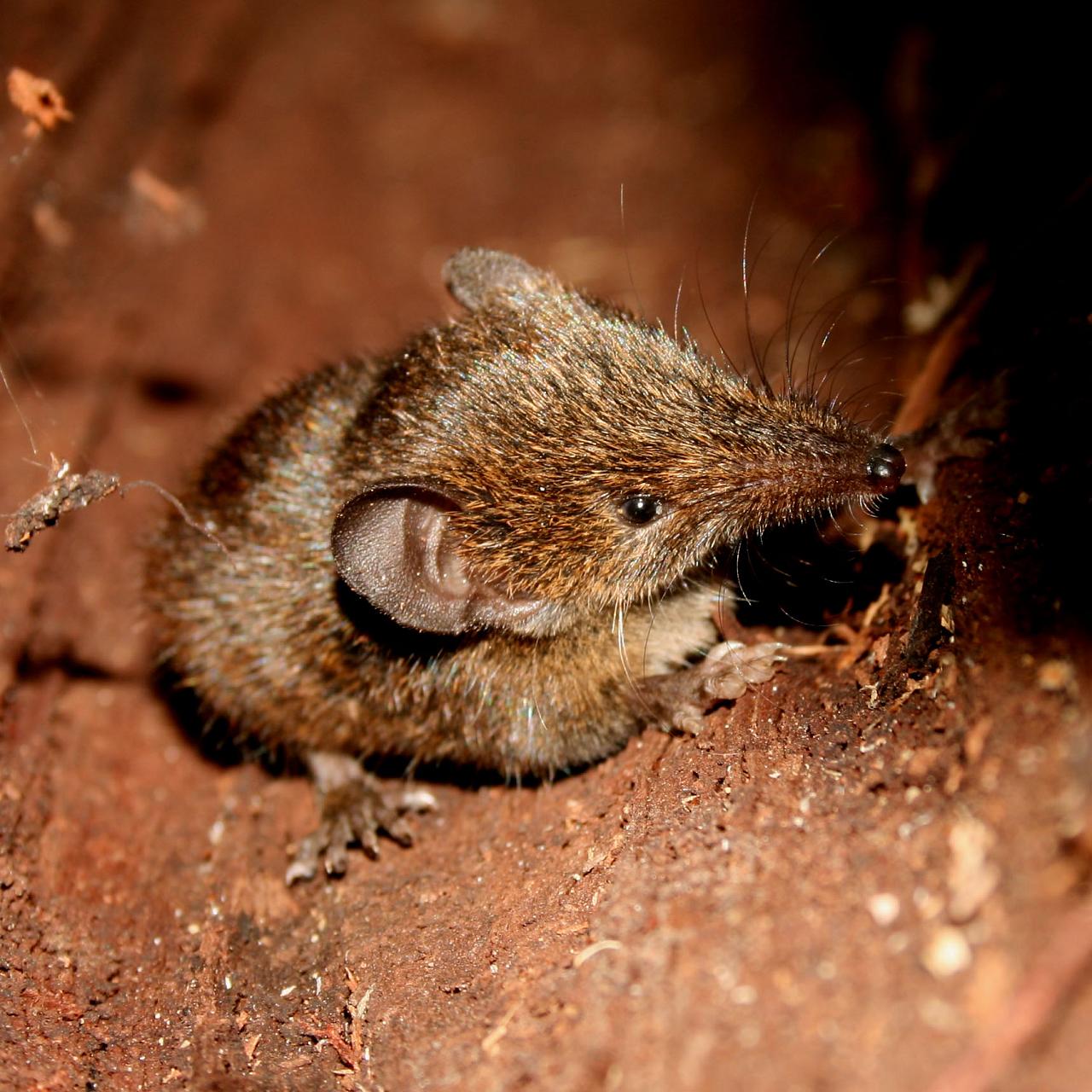
First described in 1882 by Oldfield Thomas, Cowan’s Shrew Tenrec is one of the few Microgale species with a long, bushy tail. It also stands out for its broad elevation range, from lowland rainforest to high mountain forest. This combination of traits makes it unusually adaptable among shrew tenrecs.
- NE
- DD
- LCCurrent status: Least Concern
- NT
- VU
- EN
- CR
- RE
- EW
- EX
Current status: Least Concern
What does this mean?
The assessment found a lower risk of extinction.
Categories follow the IUCN Red List.- Kingdom
- Animalia
- Phylum
- Chordata
- Class
- Mammalia
- Order
- Afrosoricida
- Suborder
- Tenrecomorpha
- Family
- Tenrecidae
- Subfamily
- Oryzorictinae
- Genus
- Microgale
- Species
- Microgale cowani
- Species group
- Tenrec
Get to know this species
Biology & ecology
Habitat
It has one of the broadest habitat ranges among shrew tenrecs and can be found in primary rainforest, degraded or logged forest, plantations, and even forest edges near agricultural fields. Despite this flexibility, detailed studies on its precise habitat preferences and population density remain scarce.
Physical traits
This tenrec is medium‑sized for its genus, with a total length ranging from approximately 143 to 156 mm and body mass between about 11 and 16 g. It has a spindle‑shaped physique, short robust limbs and a long, bushy tail nearly matching the length of its body. The coat varies widely in color, from chocolate brown with red highlights to lighter chestnut tones, with many individuals exhibiting a darker dorsal stripe and pale underparts sharply contrasted at the flanks. Its ears measure around 12 to 17 mm, and its fur is soft and densely packed. The tail is scaly but well‑covered in hairs, giving it a two‑toned appearance.
Behavior
Generally terrestrial and secretive, Cowan’s Shrew Tenrec is seldom seen, often relying on leaf litter or ground concealment for protection. It is not known to climb trees but may dig shallow burrows or nest in plant material on the forest floor. A curious grooming behavior has been documented: individuals sit on their hind legs and stroke their face from ears to nose with forepaws, sometimes keeping their jaws open. Activity patterns are not well defined, though the species appears solitary outside of brief mating encounters, occasionally leading to aggressive squealing and biting in males.
Diet
Cowan’s Shrew Tenrec is insectivorous and carnivorous, consuming primarily worms, insects such as grasshoppers, and sometimes small frogs. Dietary studies, including isotopic analysis, confirm its preference for animal prey typical of ground‑foraging insectivores. Exact proportions and seasonal variations are not documented, but its diet is consistent with physiological traits suited to a moderately high metabolism.
Reproduction
Reproductive biology of this species is poorly studied. One documented pregnant female carried one embryo per oviduct in October–November, and a single captive breeding produced three offspring weighing about 2.5 g each; unfortunately these did not survive. Born blind and hairless, the young resemble typical tenrec neonates. Eyelid and ear opening likely occurs after several weeks, but developmental timelines remain speculative. In the wild, breeding seems to occur in the late wet season, but much remains unknown.
Communication
Communication in this species is poorly understood. Observations report occasional squeals, especially in encounters between males, and possible low‑frequency vocalizations. Chemical cues and tactile signals are probably important in mother–infant interactions or courtship, as in related species, but detailed studies are lacking.
Threats
The species has a relatively broad range, presumed large population, and adaptability to degraded habitats including some protected areas such as Montagne d’Ambre, Ranomafana and Marojejy. Nonetheless, its population trends are undocumented and the species may still be affected by ongoing deforestation, agricultural expansion and habitat fragmentation. Further field surveys and ecological studies are essential to clarify its conservation outlook.
This species as pets
No records or protocols exist for the captive care of Cowan’s Shrew Tenrec. It is not maintained in zoos or private collections, and only a single captive breeding event, one female yielding three infants decades ago, is known. Without standardized husbandry information, its survival and well‑being under captive conditions remain untested.
Where does it live?
Cowan’s Shrew Tenrec is endemic to the humid forests of eastern Madagascar, inhabiting both lowland and montane zones from about 800 to 2,500 m elevation.
Linked Knowledge Hub articles
No linked public Knowledge Hub articles yet.
Linked research
No linked public research records yet.
Sources
Referenced sources
- Stephenson, P.J., Soarimalala, V. & Goodman, S. 2016. Microgale cowani. The IUCN Red List of Threatened Species 2016: e.T40586A97190403. https://dx.doi.org/10.2305/IUCN.UK.2016-1.RLTS.T40586A97190403.en. Accessed on 15 October 2026. Open source