
Short-tailed shrew tenrec
Microgale brevicaudata
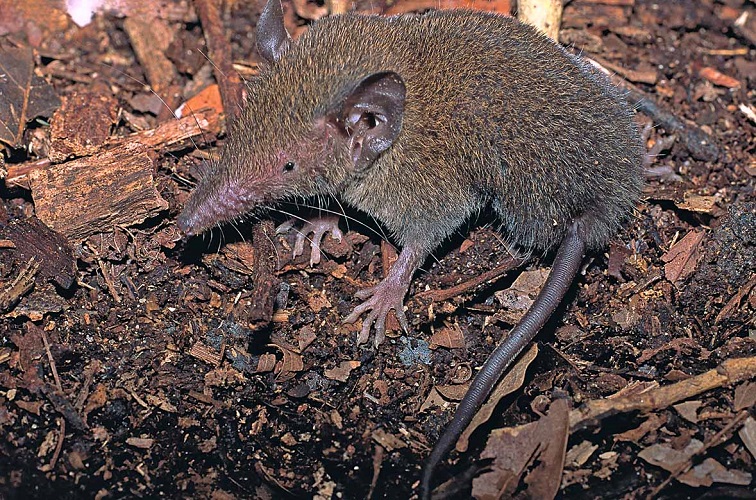
First described in 1899 by G. Grandidier, this tenrec is the only species in its genus known to possess a prehensile tail and boasts the highest vertebral count (47) of any known tenrec.
- NE
- DD
- LCCurrent status: Least Concern
- NT
- VU
- EN
- CR
- RE
- EW
- EX
Current status: Least Concern
What does this mean?
The assessment found a lower risk of extinction.
Categories follow the IUCN Red List.- Kingdom
- Animalia
- Phylum
- Chordata
- Class
- Mammalia
- Order
- Afrosoricida
- Suborder
- Tenrecomorpha
- Family
- Tenrecidae
- Subfamily
- Oryzorictinae
- Genus
- Microgale
- Species
- Microgale brevicaudata
- Species group
- Tenrec
Get to know this species
Biology & ecology
Habitat
It inhabits humid rainforests and montane moist forests between approximately 1,200 and 1,500 m elevation. It has also been recorded in marshy areas, grasslands and even agricultural fields, showing notable adaptability to human‑modified landscapes, though detailed habitat preferences remain poorly documented.
Physical traits
Weighing between 7 and 12 g and measuring around 6.6–7.0 cm in head‑body length, this petite tenrec features a short prehensile tail of about 3.3 cm. Its fur is soft and sparse, dark brown on the dorsal surface with a paler, greyish underside and a fine ringed tail. Ears are large and grey‑purple; limb proportions are unusual ,short forelimbs and longer hindlimbs, and the animal walks plantigrade. Remarkably, it has 47 vertebrae, the highest number reported for any member of Tenrecidae.
Behavior
Unlike many tenrecs, it does not enter torpor and appears active both day and night. Behavioral observations suggest a semi‑fossorial, terrestrial lifestyle, moving with short steps through leaf litter and shallow soil. It must forage almost continuously due to high metabolic demands, and while it is likely solitary like its congeners, detailed studies on social behavior and home range are lacking.
Diet
This insectivorous tenrec feeds on small arthropods and invertebrates encountered in leaf litter or shallow soil. As with other shrew‑like tenrecs, it likely forages intensively throughout active periods to meet energetic needs, though precise dietary composition is not documented.
Reproduction
Essential reproductive details remain unknown. Litter sizes are reported between one and eight offspring, with breeding systems assumed polygynandrous, mirroring related species. No data exist on gestation length, timing, birth seasonality, or developmental milestones, though reproductive cycles in congeners often correspond with Madagascar’s wet–dry seasonal cycles.
Communication
Knowledge is limited, but audible squeals and whimpering have been recorded occasionally; it may also use ultrasonic clicks and chemical cues as do other Microgale species. Visual and tactile signals may play a role in maternal and mating interactions, though no comprehensive studies exist.
Threats
This species is classified as Least concern, supported by its wide distribution and ability to persist in disturbed habitats. However, its population may be decreasing due to habitat loss from deforestation, agricultural conversion, mining, and slash‑and‑burn practices. Because it occurs in some protected areas, more field research is urgently needed to clarify population trends and ecological resilience.
This species as pets
There is virtually no documentation of this species maintained or bred in captivity. It has not been recorded in zoological institutions or private collections, and no husbandry protocols or captive breeding studies appear in the literature.
Where does it live?
The Short‑tailed Shrew Tenrec is endemic to Madagascar, confined to the central and eastern highlands.
Linked Knowledge Hub articles
No linked public Knowledge Hub articles yet.
Linked research
No linked public research records yet.
Sources
Referenced sources
- Stephenson, P.J., Soarimalala, V. & Goodman, S. 2016. Microgale brevicaudata. The IUCN Red List of Threatened Species 2016: e.T54007828A97189964. https://dx.doi.org/10.2305/IUCN.UK.2016-1.RLTS.T54007828A97189964.en. Accessed on 15 October 2026. Open source