
Highland streaked tenrec
Hemicentetes nigriceps
First described in 1875, the Highland Streaked Tenrec is unique among its relatives for possessing a specialized stridulating organ in its dorsal quills used for ultrasonic communication.
- NE
- DD
- LCCurrent status: Least Concern
- NT
- VU
- EN
- CR
- RE
- EW
- EX
Current status: Least Concern
What does this mean?
The assessment found a lower risk of extinction.
Categories follow the IUCN Red List.- Kingdom
- Animalia
- Phylum
- Chordata
- Class
- Mammalia
- Order
- Afrosoricida
- Suborder
- Tenrecomorpha
- Family
- Tenrecidae
- Subfamily
- Tenrecinae
- Tribe
- Tenrecini
- Genus
- Hemicentetes
- Species
- Hemicentetes nigriceps
- Species group
- Tenrec
Get to know this species
Biology & ecology
Habitat
This species lives primarily in humid montane and adjacent sclerophyll forests. It occupies forest understories near stream margins and occasionally rice paddies or cultivated fields at forest edges in regions like the Andringitra and Ivohibe massifs. Although it tolerates mild disturbance, it remains closely associated with riparian and montane forest habitats.
Physical traits
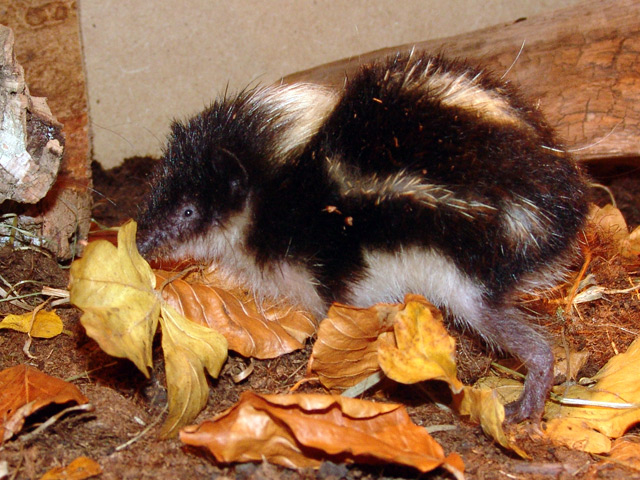
Medium in size among tenrecs, individuals range from 120 to 160 mm in total length and weigh between 70 and 160 g (averaging ~100 g). Their black-and-white striped body bears detachable barbed quills, with a crest on the head; beneath lies dense fur. The snout is long and tapered for probing soil. Unlike the lowland streaked tenrec, the Highland Streaked Tenrec lacks a tail entirely.
Behavior
Nocturnal and largely terrestrial, this species forages independently or in small groups. It stamps its forepaws to coax earthworms toward the surface, which it then probes with its snout. When threatened, it raises its quills and bucks to embed them in predators. Individuals can dig burrows up to 1.5 m long, and during colder periods, especially May through October, they enter torpor for extended periods.
Diet
Their diet is almost entirely vermivorous, consisting of earthworms and soil-dwelling invertebrates. Prey is located via a long snout and sensed through touch and chemical cues. Foraging may involve clever substrate tapping to expose worms, and nutritional intake can equal their own body weight in worms per day.
Reproduction
Breeding occurs during the wet season (November to April). Gestation lasts approximately 55–63 days, and typical litter sizes range from 2 to 8 offspring. Young develop rapidly: eyes open within a week, weaning by 18–25 days, and females become sexually mature by 35–40 days.
Communication
Highland Streaked Tenrecs are unique among Malagasy mammals in their use of stridulation: they rub specialized quills to produce ultrasonic sounds that may coordinate group foraging or serve as warnings. They also emit tongue clicks and soft squeaks; scent marking and tactile cues are thought to assist in brief interactions.
Threats
The IUCN lists this species as Least Concern, given its stable montane habitat range and occurrence in protected zones. However, ongoing habitat loss from deforestation and agricultural expansion remains a concern. Human predation and environmental disturbance may pose localized threats.
This species as pets
Although occasionally kept as an exotic pet in Madagascar, the Highland Streaked Tenrec is difficult to maintain due to its specialized diet of live worms and quill-maintenance needs. Captive lifespan is typically only 2–3 years. Long-term care protocols are nonexistent and its suitability for standard captive husbandry remains untested.
Where does it live?
This tenrec lives in the central upland regions of Madagascar between about 1,200 and 1,800 m elevation.
Linked Knowledge Hub articles
No linked public Knowledge Hub articles yet.
Linked research
No linked public research records yet.
Sources
Referenced sources
- Stephenson, P.J., Soarimalala, V. & Goodman, S. 2016. Hemicentetes nigriceps. The IUCN Red List of Threatened Species 2016: e.T62011A97189172. https://dx.doi.org/10.2305/IUCN.UK.2016-1.RLTS.T62011A97189172.en. Accessed on 17 October 2026. Open source