
Grandidier's shrew tenrec
Microgale grandidieri
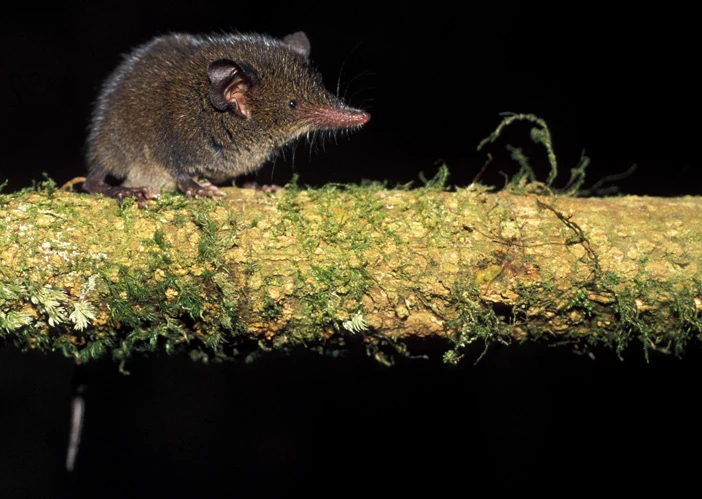
First described in 2009 by Olson et al., Grandidier’s Shrew Tenrec was split from Microgale brevicaudata based on genetic and morphological differences, and stands out for its adaptation to dry forest habitats uncommon among its relatives.
- NE
- DD
- LCCurrent status: Least Concern
- NT
- VU
- EN
- CR
- RE
- EW
- EX
Current status: Least Concern
What does this mean?
The assessment found a lower risk of extinction.
Categories follow the IUCN Red List.- Kingdom
- Animalia
- Phylum
- Chordata
- Class
- Mammalia
- Order
- Afrosoricida
- Suborder
- Tenrecomorpha
- Family
- Tenrecidae
- Subfamily
- Oryzorictinae
- Genus
- Microgale
- Species
- Microgale grandidieri
- Species group
- Tenrec
Get to know this species
Biology & ecology
Habitat
This species is known only from dry deciduous forests and dry scrubland, habitats that contrast with the more humid-forest preference typical of most shrew tenrecs. Its distribution appears patchy but extends across a range formerly considered part of M. brevicaudata, indicating under-recognized diversity in dryer ecoregions. The full details of habitat tolerance and ecological needs remain poorly studied.
Physical traits
Morphologically, M. grandidieri is similar in size to its close relatives, though specific measurements are seldom reported in the literature. In general outline it resembles other shrew tenrecs, small, slender, with short legs and a moderately long tail, but the original description highlighted distinct cranial and pelage characters that separate it from M. brevicaudata. Exact body mass, pelage coloration or tail proportions are not widely documented in open literature as of yet.
Behavior
Virtually no behavioral data exist. The species is assumed to be terrestrial and insectivorous like other Microgale, but nothing is known about its activity rhythms, nesting habits, social interactions, or thermoregulatory strategies. Its presence in dry forest suggests possible adaptations to more arid conditions than congeners, but observations are lacking.
Diet
Specific dietary data for this species have not been reported. By inference from related species, it likely preys on insects and other small invertebrates found within leaf litter or soil. No direct gut-content or observational studies are available.
Reproduction
There is no published information on reproduction. Since M. grandidieri was only formally described in 2009, reproductive timing, litter size, gestation, and development remain entirely undocumented, although general tenrec reproductive patterns likely apply.
Communication
No studies on communication have been recorded for this species. Comparable shrew tenrecs sometimes use scent marking, tactile signals, or soft squeals for social or maternal interaction, but whether M. grandidieri does so is unknown.
Threats
The IUCN currently lists Grandidier’s Shrew Tenrec as Least Concern, citing its wider-than-expected distribution and presumed large population, as well as its presence in areas of degraded dry forest. Nevertheless, its range overlaps with zones of deforestation, agricultural expansion, and mining, which may threaten local populations. More research is needed to determine actual population trends and habitat sensitivity.
This species as pets
No records exist of captive specimens or breeding of Microgale grandidieri. It is apparently unknown in zoological collections or private holdings, and no husbandry protocols have been developed.
Where does it live?
Endemic to western and southwestern Madagascar.
Linked Knowledge Hub articles
No linked public Knowledge Hub articles yet.
Linked research
No linked public research records yet.
Sources
Referenced sources
- Stephenson, P.J., Soarimalala, V. & Goodman, S. 2016. Microgale grandidieri. The IUCN Red List of Threatened Species 2016: e.T54008309A97190215. https://dx.doi.org/10.2305/IUCN.UK.2016-1.RLTS.T54008309A97190215.en. Accessed on 15 October 2026. Open source