
Large-eared tenrec
Geogale aurita
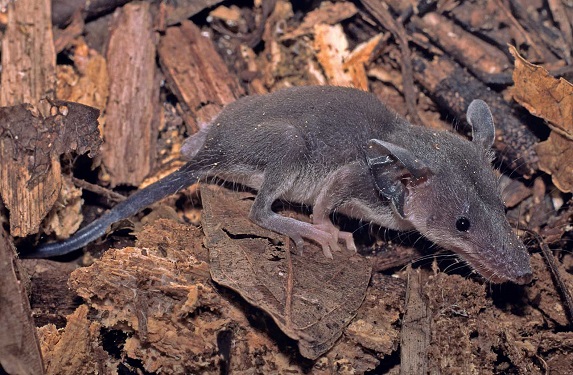
First described in 1872 by Milne‑Edwards & Grandidier, the Long‑eared Tenrec is the only extant member of its subfamily and genus and uniquely exhibits postpartum oestrus, females can conceive a new litter while still nursing another.
- NE
- DD
- LCCurrent status: Least Concern
- NT
- VU
- EN
- CR
- RE
- EW
- EX
Current status: Least Concern
What does this mean?
The assessment found a lower risk of extinction.
Categories follow the IUCN Red List.- Kingdom
- Animalia
- Phylum
- Chordata
- Class
- Mammalia
- Order
- Afrosoricida
- Suborder
- Tenrecomorpha
- Family
- Tenrecidae
- Subfamily
- Geogalinae
- Genus
- Geogale
- Species
- Geogale aurita
- Species group
- Tenrec
Get to know this species
Biology & ecology
Habitat
It lives within dry deciduous forests, gallery woodlands and spiny scrublands. While it had earlier been thought to be restricted to dry forest, more recent observations report its presence in grasslands and savanna-like anthropogenic areas, making it likely more resilient to habitat disturbance than previously believed.
Physical traits
This diminutive tenrec weighs just 5 to 8.5 g, with a head‑body length of about 60 to 75 mm and a hairy tail roughly half as long again. Its fur is short and soft, varying in dorsal hue from greyish‑brown to reddish, while the belly is buff‑white. It differs from other tenrecs by having just 34 teeth instead of the family standard of 36, and its large, sensitive ears combined with reduced vision reflect strong adaptations for locating termite prey by sound.
Behavior
Nocturnal, solitary and firmly terrestrial, the Long‑eared Tenrec lives alone except during brief breeding periods when male–female pairs may be seen together. As a heterotherm with a deliberately low metabolic rate, it often enters torpor during the heat of daytime hours, seeking shelter in concealed locations like hollow logs or underground cavities. Females may also maintain higher body temperatures during pregnancy and lactation.
Diet
This species is a specialized insectivore, feeding primarily on termites, which are located using passive auditory cues and extracted directly from their nests. Its diet likely also includes other small arthropods encountered during foraging, but termites dominate its prey spectrum.
Reproduction
Breeding extends from September through March, and the gestation period ranges from approximately 54 to 69 days. Females can delay development via embryonic diapause and may birth up to five altricial young in a single litter. Offspring are born blind and deaf, open their eyes after 21–33 days, and wean shortly thereafter. Post‑partum oestrus allows successive litters during the same season while earlier young are still being nursed.
Communication
Vision is weak in this species; instead, it relies on acute hearing and smell to detect termite prey. Large ears enable detection of faint insect movement, while tactile interaction appears crucial between mothers and offspring or mating pairs. Although no specific vocalizations have been documented, subtle acoustic or chemical signals might occur at short range.
Threats
This tenrec is considered to have a wide distribution and some tolerance to human-altered landscapes. Yet population trends remain unknown, and the species faces continued threat from deforestation and pesticide use, which may reduce termite populations essential to its survival.
This species as pets
Virtually no reliable information exists regarding captive maintenance or captive breeding of this species. It is not known to be housed in zoological collections or private holdings and remains understudied in captivity.
Where does it live?
The Long‑eared Tenrec is endemic to Madagascar, most commonly found in the island’s southwestern and western regions.
Linked Knowledge Hub articles
No linked public Knowledge Hub articles yet.
Linked research
No linked public research records yet.
Sources
Referenced sources
- Stephenson, P.J., Soarimalala, V. & Goodman, S. 2016. Geogale aurita. The IUCN Red List of Threatened Species 2016: e.T9048A97188944. https://dx.doi.org/10.2305/IUCN.UK.2016-1.RLTS.T9048A97188944.en. Accessed on 15 October 2026. Open source