
Giant otter shrew
Potamogale velox
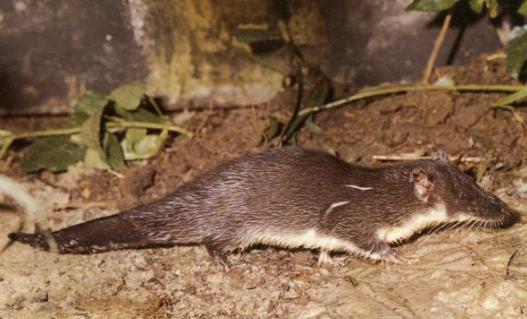
Described in 1860 by Wilhelm Peters, the Giant Otter Shrew is the only member of its genus and stands out among its relatives as the largest living species within Tenrecomorpha, with a body built for aquatic speed and stealth.
- NE
- DD
- LCCurrent status: Least Concern
- NT
- VU
- EN
- CR
- RE
- EW
- EX
Current status: Least Concern
What does this mean?
The assessment found a lower risk of extinction.
Categories follow the IUCN Red List.- Kingdom
- Animalia
- Phylum
- Chordata
- Class
- Mammalia
- Order
- Afrosoricida
- Suborder
- Tenrecomorpha
- Family
- Potamogalidae
- Genus
- Potamogale
- Species
- Potamogale velox
- Species group
- Otter shrew
Get to know this species
Biology & ecology
Habitat
It inhabits slow-moving rivers, streams, swamps, and densely vegetated freshwater habitats in both lowland rainforest and montane regions. This elusive species prefers shaded watercourses with overhanging vegetation, submerged roots, and plenty of hiding places. It is a solitary animal that creates burrows or dens in riverbanks, often with multiple exits leading to water.
Physical traits
This species is robust and streamlined, growing up to 33–35 cm in body length with an additional 35–40 cm of tail. It can weigh up to 1.2 kg, making it larger than any tenrec. Its dense, velvety fur repels water, much like an otter’s coat. The long, muscular tail is laterally flattened and acts as a powerful rudder, allowing swift, silent swimming. Unlike many mammals, the Giant Otter Shrew lacks external ears and has nostrils that close underwater. Its long, sensitive whiskers and forward-facing eyes support hunting in murky, low-light conditions.
Behavior
The Giant Otter Shrew is mostly nocturnal and extremely secretive. It spends its nights swimming along riverbanks in search of prey, hugging the shoreline and using its whiskers to detect movement. During the day, it retreats to its burrow, which may include dry chambers above the waterline for sleeping. It is territorial and generally lives alone. Despite being a skilled swimmer, it does not dive deeply and instead glides just beneath the surface, aided by rapid tail undulations. On land, its movement is more awkward, with bounding hops reminiscent of a seal or otter.
Diet
The Giant Otter Shrew is a carnivore and an active predator. It feeds on aquatic invertebrates, crabs, frogs, insect larvae, and small fish. Prey is often caught by stealth or quick sideways lunges, using its sensitive whiskers to detect vibrations. It sometimes carries its catch to land before consuming it. Its jaw is powerful enough to crush crustaceans and insect exoskeletons. Hunting occurs mostly near the shoreline or in shallow waters with dense cover.
Reproduction
Reproduction in the wild is poorly understood, but females are believed to have one or two offspring per litter. Breeding likely occurs during the rainy season when food is most abundant. Young are born in a nest chamber lined with leaves and may remain hidden there for several weeks. They are born with fur and closed eyes, and stay dependent on the mother until they can forage on their own. The species is thought to be sexually mature after about one year.
Communication
Very little is known about the vocal communication of this species, but it is thought to rely mostly on tactile and chemical cues. Scent marking likely plays a role in territory establishment. The prominent whiskers are crucial for navigating in darkness and are highly sensitive to changes in water pressure, allowing the animal to track movements without sight. Because of its solitary nature and aquatic environment, acoustic signals may be limited.
Threats
The Giant Otter Shrew is classified as Least Concern by the IUCN, but it faces growing threats from habitat destruction, water pollution, and dam construction. Because of its reliance on clean, shaded waterways, deforestation and sedimentation of rivers are especially damaging. In some areas, it is also hunted for bushmeat. Despite these pressures, the species remains widespread and has been recorded in several protected areas.
This species as pets
The Giant Otter Shrew has rarely been kept in captivity and is notoriously difficult to maintain. Its highly specialized aquatic lifestyle and carnivorous diet make it unsuitable for most zoo settings. Attempts to house it in the past have usually failed due to stress, dietary deficiencies, and lack of appropriate enclosures. As a result, almost no captive husbandry information exists, and it is not considered viable for the exotic pet trade or conservation breeding programs.
Where does it live?
The Giant Otter Shrew lives in tropical Central and West Africa, with a range stretching from Liberia and Sierra Leone to Uganda and Angola.
Linked Knowledge Hub articles
No linked public Knowledge Hub articles yet.
Linked research
No linked public research records yet.
Sources
Referenced sources
- Stephenson, P.J., Goodman, S. & Soarimalala, V. 2016. Potamogale velox. The IUCN Red List of Threatened Species 2016: e.T18095A97203526. https://dx.doi.org/10.2305/IUCN.UK.2016-1.RLTS.T18095A97203526.en. Accessed on 17 October 2026. Open source