
Rwenzori otter shrew
Micropotamogale ruwenzorii
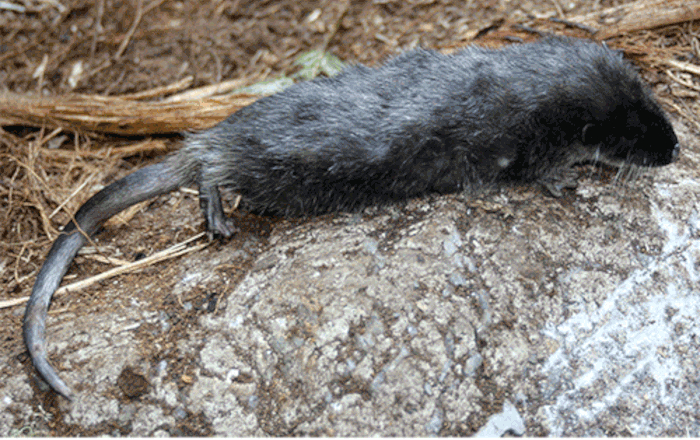
First described in 1936 by Heim de Balsac, the Rwenzori Otter Shrew is a rare, semi-aquatic mammal native to the highland rivers of Central Africa, adapted to life in fast-flowing mountain streams.
- NE
- DD
- LCCurrent status: Least Concern
- NT
- VU
- EN
- CR
- RE
- EW
- EX
Current status: Least Concern
What does this mean?
The assessment found a lower risk of extinction.
Categories follow the IUCN Red List.- Kingdom
- Animalia
- Phylum
- Chordata
- Class
- Mammalia
- Order
- Afrosoricida
- Suborder
- Tenrecomorpha
- Family
- Potamogalidae
- Genus
- Micropotamogale
- Species
- Micropotamogale ruwenzorii
- Species group
- Otter shrew
Get to know this species
Biology & ecology
Habitat
Its name comes from the Rwenzori Mountains, where it inhabits clear, cold, and fast-flowing streams with steep banks and dense vegetation. This species is rarely observed and is thought to have a very patchy distribution, restricted to high-elevation forests and montane river systems.
Physical traits
Smaller than its giant relative, the Rwenzori Otter Shrew has a body length of around 11–13 cm, with a slightly shorter tail. Its fur is dark and water-repellent, suited to its aquatic lifestyle. The tail is laterally flattened, functioning as a rudder for swimming in turbulent waters. It has no visible external ears and very small eyes, minimizing drag in water. Like other otter shrews, its whiskers are prominent and essential for detecting prey. The overall appearance is sleek and agile, built for navigating narrow, rocky streams.
Behavior
This species is thought to be strictly nocturnal and highly elusive. It spends most of its time hunting in or near water and rests in burrows or dense vegetation along the riverbank during the day. Its movement is fluid in water but awkward on land, relying on short bounds or crawls. Very little is known about its social behavior, but it is presumed to be solitary and territorial. Its lifestyle depends on pristine stream conditions, making it vulnerable to disturbance.
Diet
This species is a carnivorous forager, feeding on aquatic insects, larvae, small crustaceans, and other invertebrates found in streambeds. It uses its whiskers to sense vibrations in the water and swiftly captures prey with quick, lateral head movements. It typically eats its catch while perched on rocks or streambanks. Its specialized diet ties it closely to healthy, oxygen-rich waters with a stable supply of aquatic life.
Reproduction
Virtually nothing is known about the breeding behavior of this species. Like other members of Potamogalidae, it is believed to have small litters and a low reproductive rate. Births likely occur during or after the rainy season. Juveniles are assumed to be born in concealed nests above the waterline and remain with the mother until fully weaned. More research is needed to understand its development and population dynamics.
Communication
Direct observations are lacking, but the Rwenzori Otter Shrew likely communicates using scent and touch rather than sound. Like its relatives, it may use glandular secretions for marking territory or signaling reproductive readiness. Its long, sensitive whiskers are essential for detecting prey and navigating fast-flowing water, especially at night.
Threats
The Rwenzori Otter Shrew is listed as Least Concern by the IUCN. Its highly specialized habitat makes it potentially vulnerable to water pollution, deforestation, and changes in river flow caused by agriculture or development. Because of its restricted range and reliance on highland streams, even localized environmental damage could have a significant impact on the species.
This species as pets
There are no known records of the Rwenzori Otter Shrew being kept in captivity. Its small size, elusive behavior, and dependence on cold, fast-moving water make it extremely difficult to maintain in artificial environments. Conservation efforts focus entirely on protecting its natural habitat, particularly the forested stream systems of the Ruwenzori and neighboring mountain ranges.
Where does it live?
The Rwenzori Otter Shrew lives in a small, mountainous region of Central Africa, including parts of the Democratic Republic of the Congo, Rwanda, and Uganda.
Linked Knowledge Hub articles
No linked public Knowledge Hub articles yet.
Linked research
No linked public research records yet.
Sources
Referenced sources
- Stephenson, P.J. 2016. Micropotamogale ruwenzorii. The IUCN Red List of Threatened Species 2016: e.T13394A21287768. https://dx.doi.org/10.2305/IUCN.UK.2016-1.RLTS.T13394A21287768.en. Accessed on 17 October 2026. Open source