
Madras hedgehog
Paraechinus nudiventris
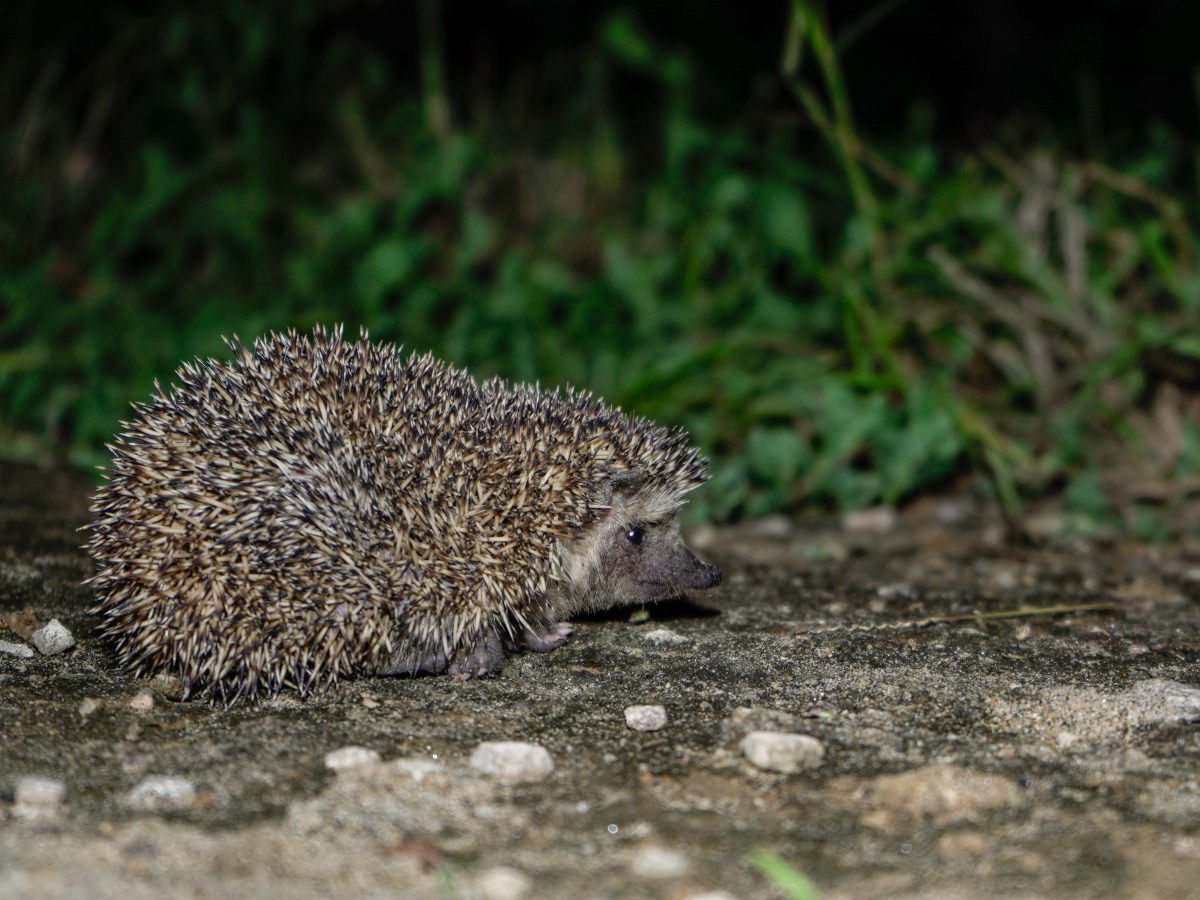
First described in 1851 by Horsfield. It is unique among hedgehogs for its almost completely bare underside with little or no fur. This rare species is restricted to southeastern India.
- NE
- DD
- LCCurrent status: Least Concern
- NT
- VU
- EN
- CR
- RE
- EW
- EX
Current status: Least Concern
What does this mean?
The assessment found a lower risk of extinction.
Categories follow the IUCN Red List.- Kingdom
- Animalia
- Phylum
- Chordata
- Class
- Mammalia
- Order
- Eulipotyphla
- Family
- Erinaceidae
- Subfamily
- Erinaceinae
- Genus
- Paraechinus
- Species
- Paraechinus nudiventris
- Species group
- Hedgehogs
Get to know this species
Biology & ecology
Habitat
It is known from dry deciduous forests, scrublands, and open grasslands, especially in the states of Tamil Nadu and Andhra Pradesh. It is most commonly observed in areas with light human activity, including agricultural fields and the edges of rural settlements, where it can find food and shelter. The species was long thought to be rare, but more recent sightings suggest it may be underreported rather than truly scarce. Its preferred habitats tend to include sandy or soft soil for burrowing, combined with moderate vegetation cover for nesting and foraging. This hedgehog avoids dense forest or heavily irrigated areas, and it appears to adapt relatively well to certain modified landscapes.
Physical traits
The Madras hedgehog is a small, compact species characterized by a sparse or completely bare underside, which gives the species its common name. This lack of ventral fur sets it apart from most other…
Read full text
The Madras hedgehog is a small, compact species characterized by a sparse or completely bare underside, which gives the species its common name. This lack of ventral fur sets it apart from most other hedgehog species. The dorsal surface is covered in dense, short spines that are generally brown or black with lighter tips, and the facial coloration is usually uniform without the dark mask seen in some relatives. The ears are prominent and the snout is pointed, adapted for rooting through leaf litter and soil. Body length is estimated at around 14 to 21 centimeters, with a weight range likely between 300 and 500 grams, though detailed morphometric data is lacking in published literature. Sexual dimorphism has not been clearly described, and there is minimal documentation of seasonal or age-related variation in appearance.
Behavior
Very little is known about the daily or seasonal behavior of the Madras hedgehog. Like most hedgehogs, it is presumed to be nocturnal and solitary, foraging at night and sheltering during the day in …
Read full text
Very little is known about the daily or seasonal behavior of the Madras hedgehog. Like most hedgehogs, it is presumed to be nocturnal and solitary, foraging at night and sheltering during the day in burrows or natural cover. Its activity may be influenced by seasonal rainfall, with increased movement and feeding during or after the monsoon season when invertebrate prey becomes more abundant. There is currently no published evidence of hibernation or aestivation in this species, but given its environment, it is unlikely to enter long-term torpor. Observations in rural areas suggest that it may be tolerant of human proximity if undisturbed, although its elusive nature and low population density make direct study difficult. Without telemetry or systematic field research, much of its behavior remains speculative and extrapolated from better-known species in the same genus.
Diet
The diet of the Madras hedgehog has not been studied in detail, but it is assumed that, like other members of the family Erinaceidae, it is an insectivore that forages opportunistically. It likely fe…
Read full text
The diet of the Madras hedgehog has not been studied in detail, but it is assumed that, like other members of the family Erinaceidae, it is an insectivore that forages opportunistically. It likely feeds on a variety of invertebrates, such as beetles, caterpillars, ants, termites, and other soil-dwelling insects. It is possible that it occasionally consumes small vertebrates, eggs, or plant material, though this has yet to be confirmed. The hedgehog presumably uses its keen sense of smell and mobile snout to locate prey in loose soil or among leaf litter. In the absence of direct data, the ecological role of the species remains largely unknown. Further research, such as the analysis of feces or stomach contents, is required to determine the diet and feeding ecology of this poorly studied animal.
Reproduction
There is no published research on the reproductive behavior or lifecycle of the Paraechinus nudiventris. Based on related species, it may breed once or twice annually, possibly during or after the ra…
Read full text
There is no published research on the reproductive behavior or lifecycle of the Paraechinus nudiventris. Based on related species, it may breed once or twice annually, possibly during or after the rainy season when food availability is highest. Litter size is presumed to be between three and six offspring, though this has not been documented in the wild or captivity. The young are likely born blind and without hardened spines, with developmental milestones similar to other hedgehogs: eyes opening after approximately two weeks and weaning by four to six weeks of age. Sexual maturity is likely reached within a year, though this depends heavily on environmental factors and resource availability. The average lifespan in the wild remains unknown, but may be similar to other Paraechinus species, ranging from three to five years.
Communication
As with other hedgehogs, the Madras hedgehog is expected to rely primarily on olfactory signals for communication, particularly for marking territory and during the mating season. Scent glands, likel…
Read full text
As with other hedgehogs, the Madras hedgehog is expected to rely primarily on olfactory signals for communication, particularly for marking territory and during the mating season. Scent glands, likely located in the anal region, are presumed to play a role in chemical signaling, although this has not been formally documented in the species. Acoustic communication is probably limited to defensive hissing or clicking sounds, as observed in other Paraechinus species, but no recordings or behavioral studies have confirmed this in Madras hedgehogs. Self-anointing behavior is common in many hedgehogs and may occur in this species as well, though again, there is no direct research available. The species’ shy and nocturnal habits make communication research especially challenging without long-term observation or captive studies.
Threats
Habitat loss due to agricultural expansion, infrastructure development, and urbanization poses a significant risk to its survival in some regions. Pesticide use may reduce insect prey availability and pose toxicological risks. The species may also be hunted in some areas for local medicine or out of fear or misunderstanding. Road mortality is a growing concern, especially near expanding rural settlements. Despite these pressures, the species appears to persist in some human-altered landscapes, which suggests a degree of adaptability. However, systematic surveys are needed to confirm population stability and identify conservation priorities, particularly in unprotected habitats.
This species as pets
The Madras hedgehog is extremely rare in captivity and is not found in zoos, wildlife centers, or the exotic pet trade. There are no known breeding programs or husbandry records specific to this spec…
Read full text
The Madras hedgehog is extremely rare in captivity and is not found in zoos, wildlife centers, or the exotic pet trade. There are no known breeding programs or husbandry records specific to this species. Its care requirements are unknown, and it is considered unsuitable for captivity except under specialized research or conservation conditions. Given its restricted range and limited ecological data, in-situ conservation should be prioritized. Any attempt to maintain this species in captivity would require close collaboration with local authorities, habitat specialists, and veterinarians familiar with desert-adapted mammals. As of now, all known information comes from wild observations and sporadic field reports.
Where does it live?
The Madras hedgehog is endemic to southeastern India.
Linked Knowledge Hub articles
No linked public Knowledge Hub articles yet.
Linked research
No linked public research records yet.
Sources
Referenced sources
- Chakraborty, S., Srinivasulu, C. & Molur, S. 2017. Paraechinus nudiventris. The IUCN Red List of Threatened Species 2017: e.T39594A22326706. https://dx.doi.org/10.2305/IUCN.UK.2017-2.RLTS.T39594A22326706.en. Accessed on 15 October 2026. Open source