
Kitanglad gymnure
Podogymnura minima
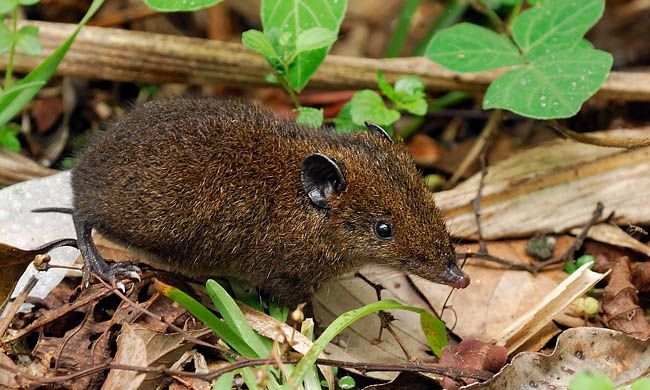
Recognized as a distinct species in 2023, the Kitanglad Gymnure is the smallest known member of its genus, found exclusively in the cloud forests of the Kitanglad Mountain Range in Mindanao.
- NECurrent status: Not Evaluated
- DD
- LC
- NT
- VU
- EN
- CR
- RE
- EW
- EX
Current status: Not Evaluated
What does this mean?
This species has not been assessed yet.
Categories follow the IUCN Red List.Not Assessed
- Kingdom
- Animalia
- Phylum
- Chordata
- Class
- Mammalia
- Order
- Eulipotyphla
- Family
- Erinaceidae
- Subfamily
- Galericinae
- Genus
- Podogymnura
- Species
- Podogymnura minima
- Species group
- Gymnure
Get to know this species
Biology & ecology
Habitat
It inhabits montane forest, including swampy and mossy patches, usually found at elevations between 1,300 and 2,800 m. Within this cloud forest environment, individuals are most often encountered along narrow ground paths, beneath moss-covered roots, fallen logs, or leaf litter, environments rich in invertebrate prey.
Physical traits
The Kitanglad Gymnure is the smallest species in the Podogymnura genus, with a body length of around 13.7 to 15.2 cm, and a tail of 4.9 to 6.6 cm, making it about 36 % the length of its body. Weight ranges between 63 and 79 g. The fur is soft, long, and dark reddish-brown, with faint golden-yellow tips that give a subtle speckled appearance. Its ears (2.0–2.2 cm) and feet are pale, and the tail is uniformly light-colored underneath. The skull is slender, with a long, pointed rostrum and relatively short parietal crests. The skull length is between 37.3 and 39.8 mm, with a braincase width around 15–16 mm.
Behavior
This gymnure is nocturnal and terrestrial, moving through dense forest floor debris and using hidden runways for movement. It is likely solitary and highly secretive, its small size and cryptic behavior make it seldom seen. It shows a preference for moist, moss-rich forest floors and avoids open or disturbed terrain.
Diet
Stomach content analyses show that it feeds predominantly on earthworms, which account for about half of its diet, and also consumes various arthropods such as weta or ground-dwelling insects, often chewing its prey into small 3–20 mm pieces.
Reproduction
Females typically produce one offspring, though rarely two. Juveniles and sexually active males have been observed between March and June, suggesting a possible seasonal breeding period. Detailed life history information remains limited.
Communication
No specific studies exist, but like other gymnures, it likely relies on scent marking, subtle tactile cues, and possibly soft vocalizations. Its cryptic lifestyle in dense forest suggests that chemical communication is paramount.
Threats
This gymnure is currently not assessed separately by the IUCN and remains grouped under the Mindanao Gymnure, which is considered Least Concern. Despite residing within the protected Mount Kitanglad Range Natural Park, it faces threats from local deforestation and habitat disturbance that may impact its highly localized populations.
This species as pets
There are no known records of the Kitanglad Gymnure being held in captivity. Its specialized habitat, small population, and elusive nature make it unsuitable for captive maintenance or breeding programs. Conservation focus is, now more than ever, fully in situ, preserving the montane forests it calls home.
Where does it live?
This species is endemic to the Kitanglad Mountain Range in northern Mindanao, Philippines.
Linked Knowledge Hub articles
No linked public Knowledge Hub articles yet.
Linked research
No linked public research records yet.
Sources
Referenced sources
- Balete D S, Heaney L R, Rickart E A, Quidlat R S, Rowsey D M, Olson L E, plazi (2023). A re-assessment of diversity among Philippine gymnures (Mammalia: Erinaceidae Podogymnura), with a new species from eastern Mindanao. Plazi.org taxonomic treatments database. Checklist dataset https://doi.org/10.15468/bnb6qm accessed via GBIF.org on 2026-10-17. Open source