
Long-eared gymnure
Otohylomys megalotis
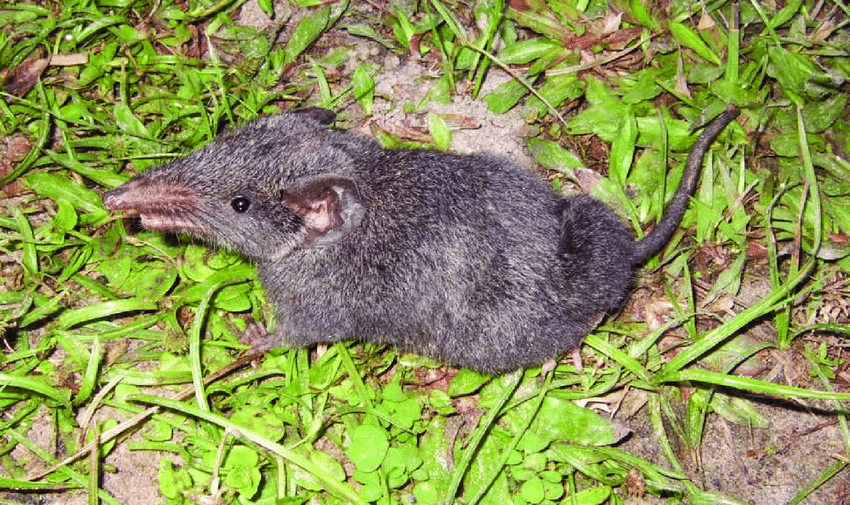
Originally described in 1940 by Heller, the Long‑eared Gymnure was long classified under the genus Hylomys, but has recently been reassigned to its own unique genus: Otohylomys. It is the only known species in this genus, easily recognized by its unusually large ears.
- NECurrent status: Not Evaluated
- DD
- LC
- NT
- VU
- EN
- CR
- RE
- EW
- EX
Current status: Not Evaluated
What does this mean?
This species has not been assessed yet.
Categories follow the IUCN Red List.Data Deficient
- Kingdom
- Animalia
- Phylum
- Chordata
- Class
- Mammalia
- Order
- Eulipotyphla
- Family
- Erinaceidae
- Subfamily
- Galericinae
- Genus
- Otohylomys
- Species
- Otohylomys megalotis
- Species group
- Gymnure
Get to know this species
Biology & ecology
Habitat
Their distribution is small and limited to dense forest with abundant ground cover. Because of recent reclassification and incomplete surveys, their full range remains uncertain.
Physical traits
This gymnure is small and lightly built, about 10–14 cm long, with a tiny tail. Its most distinctive feature is its very large ears—bigger than those of any other gymnure—which aid in hearing and possibly help regulate temperature. Its fur is coarse and grey‑brown, it has a sharp snout, short limbs, and weighs roughly 20–60 grams.
Behavior
Long‑eared Gymnures are nocturnal, solitary, and remain hidden during the day under logs or in leaf litter. They move quickly through dense ground vegetation, relying on stealth for protection. Their large ears enhance detection of predators and prey in dark, cluttered understory environments.
Diet
They are generalist insectivores, feeding on insects, worms, larvae, and small invertebrates, and possibly consuming small amounts of fungi or plant debris. Their sharp teeth and pointed snout are well suited for probing leaf litter to uncover prey.
Reproduction
No reproductive studies exist. They probably give birth to 2–4 altricial (blind, helpless) young in hidden nests, with breeding likely controlled by seasonal environmental factors.
Communication
Little is known about their communication, but they likely use chemical signals—scent marking and soft vocalizations such as grunts. Their large ears may pick up vocal or movement cues from others, but field data are limited.
Threats
Classified as Data Deficient due to limited data, Long‑eared Gymnures may be threatened by habitat loss and deforestation in Vietnam’s highlands. Their rarity and narrow range heighten their vulnerability.
This species as pets
There are no records of Long‑eared Gymnures ever being kept in captivity. Their elusive nature and specialized habitat needs make them unsuited for captivity; conservation efforts must focus on protecting their natural forest habitat.
Where does it live?
Long‑eared Gymnures are found only in Laos, where they live in moist montane forests between 1,000 and 1,800 meters elevation.
Linked Knowledge Hub articles
No linked public Knowledge Hub articles yet.
Linked research
No linked public research records yet.
Sources
Referenced sources
- Hylomys megalotis Jenkins & M. F. Robinson, 2002 in Bánki, O., Roskov, Y., Döring, M., Ower, G., Hernández Robles, D. R., Plata Corredor, C. A., Stjernegaard Jeppesen, T., Örn, A., Pape, T., Hobern, D., Garnett, S., Little, H., DeWalt, R. E., Miller, J., Orrell, T., Aalbu, R., Abbott, J., Abreu, C., Acero P, A., et al. (2026). Catalogue of Life (2026-08-26 XR). Catalogue of Life Foundation, Amsterdam, Netherlands. https://doi.org/10.48580/dgyy9 Open source
- Chiozza, F. 2016. Hylomys megalotis. The IUCN Red List of Threatened Species 2016: e.T136193A22324783. https://dx.doi.org/10.2305/IUCN.UK.2016-1.RLTS.T136193A22324783.en. Accessed on 17 October 2026. Open source