
Hainan gymnure
Neohylomys hainanensis
First described in 1959, the Hainan Gymnure was long considered part of the Hylomys genus, but genetic studies have confirmed it deserves its own genus, Neohylomys.
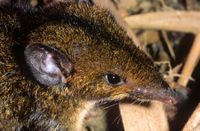
- NE
- DD
- LC
- NT
- VUCurrent status: Vulnerable
- EN
- CR
- RE
- EW
- EX
Current status: Vulnerable
What does this mean?
This species faces a high risk of extinction in the wild.
Categories follow the IUCN Red List.- Kingdom
- Animalia
- Phylum
- Chordata
- Class
- Mammalia
- Order
- Eulipotyphla
- Family
- Erinaceidae
- Subfamily
- Galericinae
- Genus
- Neohylomys
- Species
- Neohylomys hainanensis
- Species group
- Gymnure
Get to know this species
Biology & ecology
Habitat
It occupies tropical dry and montane forests, including fragmented or secondary forests, often near streams, shrubland, and rocky or woody debris. Its distribution spans low to high altitudes of the island, but habitat loss threatens its limited range.
Physical traits
With a body length between 12 and 14.7 cm and a relatively long tail (about 3.6 to 4.3 cm, around 30% of body length), it weighs between 50 and 70 g. Its fur is reddish-brown with a distinct black dorsal stripe, and paler underparts. The tail, ears, and feet are nearly hairless, and the snout is long and flexible, features well suited to probing soil and forest litter.
Behavior
Primarily nocturnal or crepuscular, this gymnure forages along the forest floor and uses burrows or dense underbrush for daytime refuge. It was once thought to be subterranean, but current evidence suggests burrows serve refuge rather than foraging. It relies on speed, scent, and stealth, not defensive spines, to evade predators.
Diet
It feeds primarily on insects and earthworms, using its agile snout to probe leaf litter. Its ecological role is likely as a ground-foraging insectivore, though dietary specifics remain unstudied.
Reproduction
Little is known. Insights from related gymnure species suggest a small litter size born altricial, though breeding season and life cycle details remain undocumented.
Communication
Details are lacking, but like related species, it likely uses scent marking and possibly quiet vocalizations to communicate. Its heightened sense of smell is probably well suited for both territorial signaling and navigating its environment.
Threats
The Hainan Gymnure is listed as Vulnerable due to its extremely limited range and severe habitat loss from deforestation and agricultural encroachment. There are no known population estimates, and conservation requires urgent habitat protection.
This species as pets
There are no known records of the Hainan Gymnure in captivity. Its rarity, secretive habits, and specific habitat needs make captive maintenance unfeasible. Conservation must focus on in situ protection.
Where does it live?
This species exists only on Hainan Island, China, and was recently also found in northern Vietnam.
Linked Knowledge Hub articles
No linked public Knowledge Hub articles yet.
Linked research
No linked public research records yet.
Sources
Referenced sources
- Turvey, S.T. & Liu, H. 2026. Neohylomys hainanensis. The IUCN Red List of Threatened Species 2026: e.T10588A269332956. https://dx.doi.org/10.2305/IUCN.UK.2026-1.RLTS.T10588A269332956.en. Accessed on 17 October 2026. Open source