
Leuser gymnure
Hylomys vorax
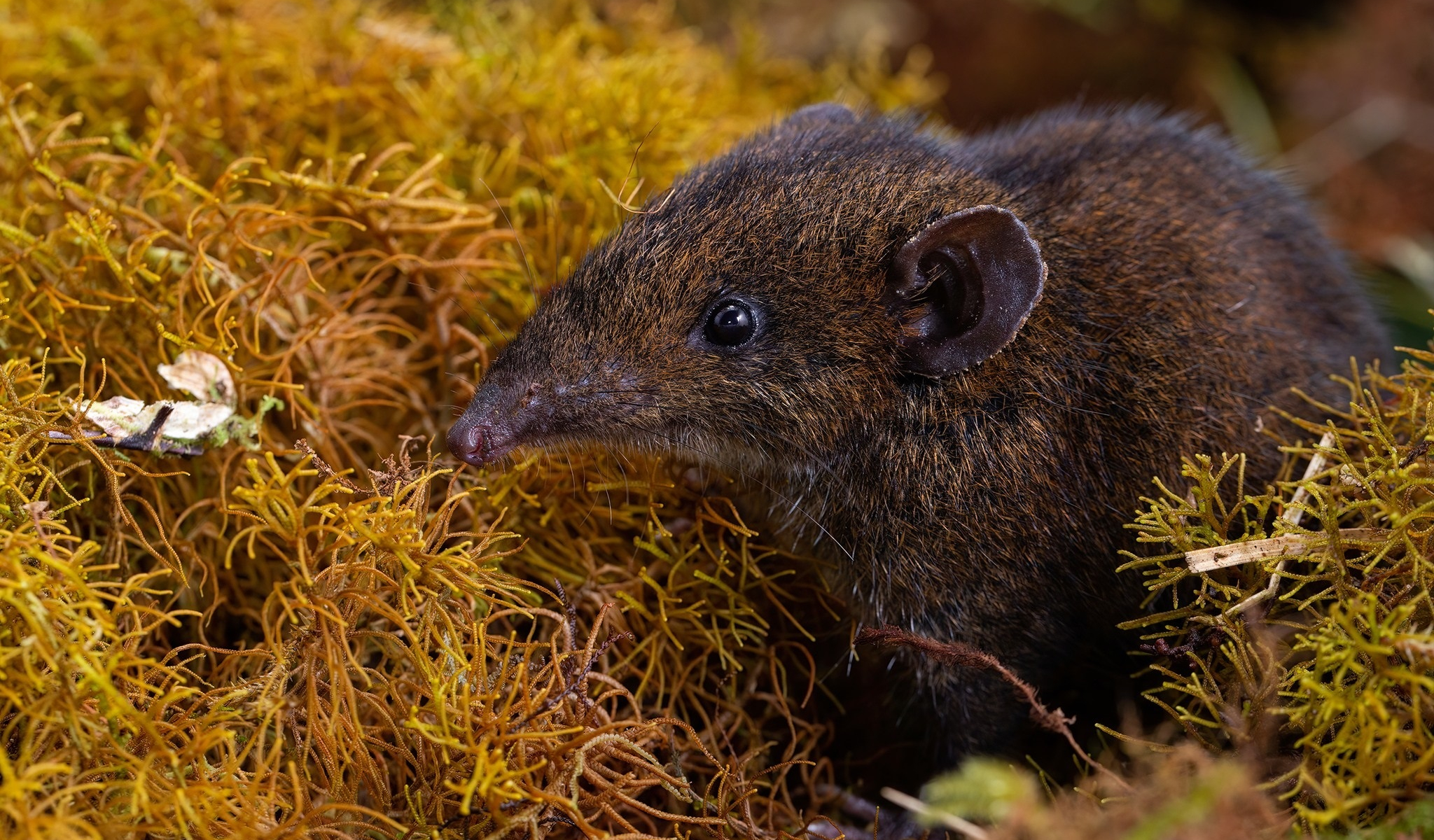
Formally described in 2023, the Leuser Gymnure is known only from high-altitude forests of Mount Leuser in northern Sumatra.
- NECurrent status: Not Evaluated
- DD
- LC
- NT
- VU
- EN
- CR
- RE
- EW
- EX
Current status: Not Evaluated
What does this mean?
This species has not been assessed yet.
Categories follow the IUCN Red List.Not Assessed
- Kingdom
- Animalia
- Phylum
- Chordata
- Class
- Mammalia
- Order
- Eulipotyphla
- Family
- Erinaceidae
- Subfamily
- Galericinae
- Genus
- Hylomys
- Species
- Hylomys vorax
- Species group
- Gymnure
Get to know this species
Biology & ecology
Habitat
Its preferred habitat includes moist montane forests rich in moss, ferns, and thick ground cover, as well as open heathy plateaus above the tree line, where rhododendrons, Vaccinium species, and low shrubs dominate. Its entire known range lies within a national park, yet human-driven forest loss, fires, and road development continue to fragment its habitat.
Physical traits
A mid-sized gymnure, the Leuser Gymnure measures between 13.9 and 15 cm in total length, with a tail roughly 2.1–2.2 cm long (about 17.5% of its body length). It weighs between 40 and 54 g. Its soft, dark brown fur transitions to a lighter underside, and it has a uniformly colored tail, unlike the bicolored tails of some relatives. The throat may show pale yellow tones. Its ears are moderate in size (1.8–2 cm), and its body resembles a shrew in profile. Detailed skull structure reflects slight differences from related species, but its compact, insectivorous form is clear.
Behavior
Little is known, but stomach content analysis suggests a diet rich in earthworms, and individuals have been trapped under moss-covered logs, tree roots, or grassy mats near forest edges. One adult and two subadults were caught together, implying possible parental care or overlapping territories. Notably, adults emit a faint but recognizable pig-like odor, not recorded in juveniles.
Diet
Known primarily to consume earthworms, based on gut analyses. Its montane foraging habitat suggests it may also feed opportunistically on forest-floor invertebrates, though no studies confirm broader dietary habits.
Reproduction
No reproductive data exist. Observations of adult and juvenile captures together hint at potential parent-offspring association, but breeding timing, litter size, and development remain unstudied.
Communication
Direct observations are lacking, but like other gymnures, the Leuser species likely uses scent marking, subtle tactile cues, and possibly soft vocal sounds to communicate, given their secretive nature and dense forest habitat.
Threats
Not yet assessed by the IUCN, the Leuser Gymnure faces habitat threats from deforestation, fires, oil palm expansion, illegal roads, and the looming threat of the Trans-Sumatra Highway. Despite being located within a national park, its specialized montane habitat remains under pressure.
This species as pets
There are no records of this species in captivity. Its limited known range, elusive behavior, and specific habitat needs make it unlikely to be maintained outside its natural environment.
Where does it live?
This species is confined to Mount Leuser in northern Sumatra, Indonesia, living at elevations between roughly 2,073 and 2,835 m, with peak abundance around 2,073 to 2,408 m.
Linked Knowledge Hub articles
No linked public Knowledge Hub articles yet.
Linked research
No linked public research records yet.
Sources
Referenced sources
- Arlo Hinckley, Miguel Camacho-Sanchez, Marcus A H Chua, Manuel Ruedi, Darrin Lunde, Jesús E Maldonado, Hasmahzaiti Omar, Jennifer A Leonard, Melissa T R Hawkins, An integrative taxonomic revision of lesser gymnures (Eulipotyphla: Hylomys) reveals five new species and emerging patterns of local endemism in Tropical East Asia, Zoological Journal of the Linnean Society, Volume 202, Issue 2, October 2024, zlad177, https://doi.org/10.1093/zoolinnean/zlad177 Open source