
Javan short-tailed gymnure
Hylomys suillus
Described in 1848 by Müller, the Javan Short-tailed Gymnure is one of the most widespread gymnure species, known for its adaptability to both lowland and montane forests across Southeast Asia.
- NE
- DD
- LCCurrent status: Least Concern
- NT
- VU
- EN
- CR
- RE
- EW
- EX
Current status: Least Concern
What does this mean?
The assessment found a lower risk of extinction.
Categories follow the IUCN Red List.- Kingdom
- Animalia
- Phylum
- Chordata
- Class
- Mammalia
- Order
- Eulipotyphla
- Family
- Erinaceidae
- Subfamily
- Galericinae
- Genus
- Hylomys
- Species
- Hylomys suillus
- Species group
- Gymnure
Get to know this species
Biology & ecology
Habitat
It inhabits tropical lowland and montane forests, ranging from sea level up to elevations above 1,500 meters. It prefers moist, shaded environments with abundant leaf litter, such as primary and secondary forest floors, but has also been found in disturbed habitats, showing a notable degree of ecological flexibility.
Physical traits
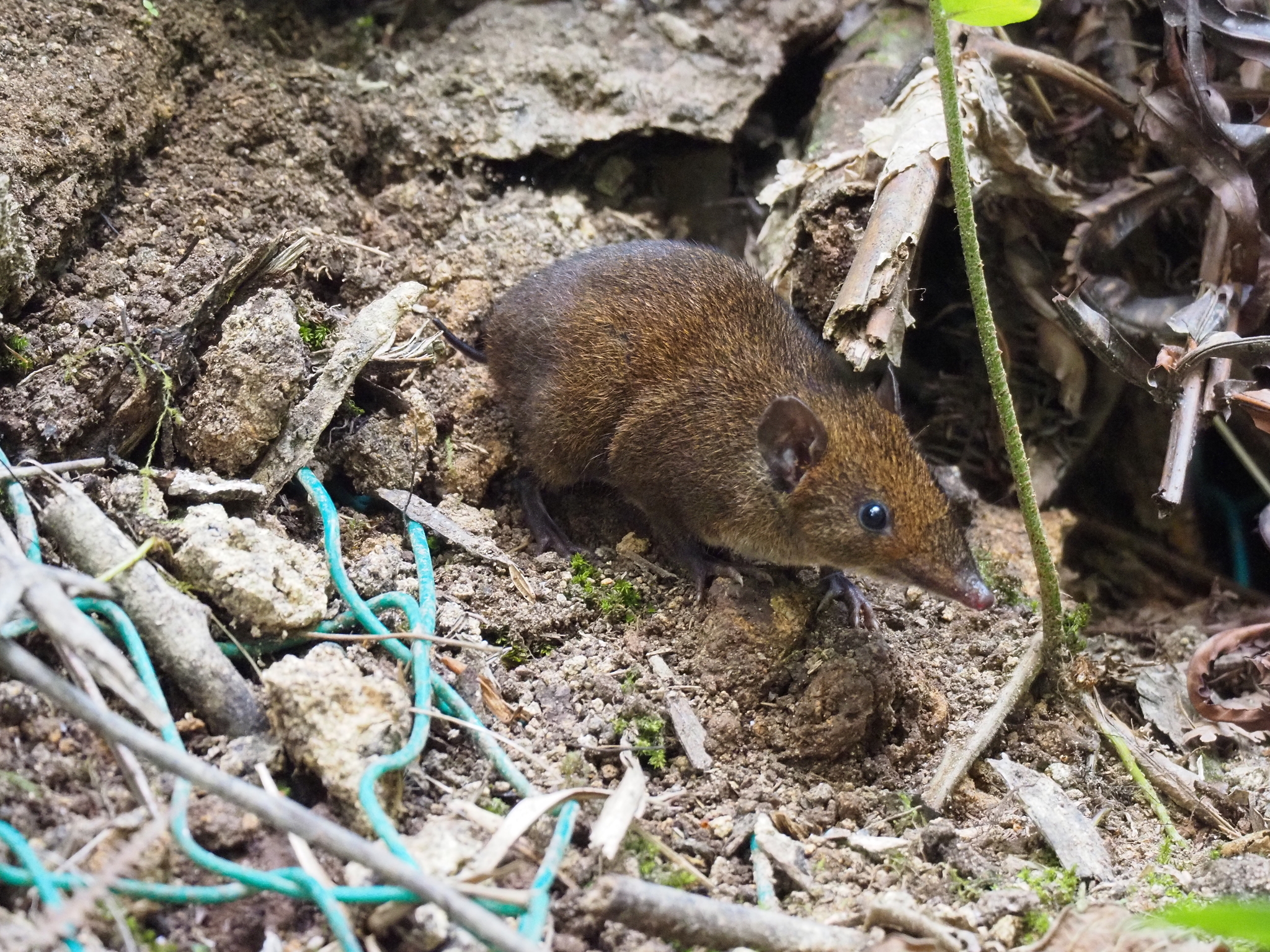
This species is small and sturdy, with a body length of 10–14 cm and a short tail measuring just a few centimeters. It weighs between 30–100 grams. The fur is coarse and typically brownish or grey, helping it blend into the forest floor. It has a pointed snout, rounded ears, and short limbs adapted for scurrying through dense vegetation. Compared to some of its relatives, it has a relatively compact body and a reduced tail, giving it a distinct silhouette.
Behavior
Javan Short-tailed Gymnures are nocturnal and solitary. They spend the night foraging for food and the day hiding in leaf litter, under logs, or in burrows. They do not hibernate and are active throughout the year. Agile and quick, they rely on stealth and speed rather than defense. Their foraging style involves sniffing and rooting in soft soil and debris. Though they are not often seen, signs of their activity include small diggings and faint trails in the underbrush.
Diet
Javan Short-tailed Gymnures are insectivores, with a diet consisting primarily of insects, earthworms, larvae, and other invertebrates. They may also consume small vertebrates, fungi, and decaying plant matter. They forage by sniffing through the leaf litter, often flipping it over with their snouts in search of hidden prey. This generalist approach to feeding helps them adapt to a variety of forest conditions.
Reproduction
While data on this species is limited, it is believed to reproduce throughout the year in suitable environments. Females likely give birth to two to four young in a nest hidden under vegetation or within burrows. The newborns are altricial, meaning they are born blind and helpless. They grow quickly and remain in the nest for several weeks before becoming independent. Parental care is provided solely by the mother.
Communication
These gymnures likely use scent marking to establish territory and recognize individuals. Their communication may also include soft vocalizations, such as grunts or squeaks, especially during courtship or conflict. As in other Galericinae, chemical signals probably play an important role in reproduction and territoriality, though direct observations remain limited.
Threats
The Javan Short-tailed Gymnure is listed as Least Concern by the IUCN, largely due to its wide distribution and apparent adaptability. However, deforestation, habitat fragmentation, and conversion of land for agriculture are ongoing threats in many parts of its range. Populations in heavily disturbed or isolated areas may be more vulnerable than currently documented.
This species as pets
Javan Short-tailed Gymnures are rarely kept in captivity, although there are occasional reports from research facilities. They are sensitive to changes in temperature and humidity, and their specific dietary needs and secretive nature make them difficult to maintain outside of their natural habitat. They are not suitable as pets and are primarily of interest in ecological and evolutionary research.
Where does it live?
The Javan Short-tailed Gymnure has a broad distribution across parts of Indonesia, Malaysia, Thailand, Vietnam, and Laos, including the islands of Java and Sumatra.
Linked Knowledge Hub articles
No linked public Knowledge Hub articles yet.
Linked research
No linked public research records yet.
Sources
Referenced sources
- Arlo Hinckley, Miguel Camacho-Sanchez, Marcus A H Chua, Manuel Ruedi, Darrin Lunde, Jesús E Maldonado, Hasmahzaiti Omar, Jennifer A Leonard, Melissa T R Hawkins, An integrative taxonomic revision of lesser gymnures (Eulipotyphla: Hylomys) reveals five new species and emerging patterns of local endemism in Tropical East Asia, Zoological Journal of the Linnean Society, Volume 202, Issue 2, October 2024, zlad177, https://doi.org/10.1093/zoolinnean/zlad177 Open source
- Chiozza, F. 2016. Hylomys suillus (errata version published in 2017). The IUCN Red List of Threatened Species 2016: e.T40611A115175083. https://dx.doi.org/10.2305/IUCN.UK.2016-3.RLTS.T40611A22324887.en. Accessed on 17 October 2026. Open source