
Northern short-tailed gymnure
Hylomys peguensis
First described in 1859, the Northern Short-tailed Gymnure was long thought to be a subspecies of the Short-tailed Gymnure, but molecular and morphological research in 2023 confirmed it as a distinct species widespread across mainland Southeast Asia.
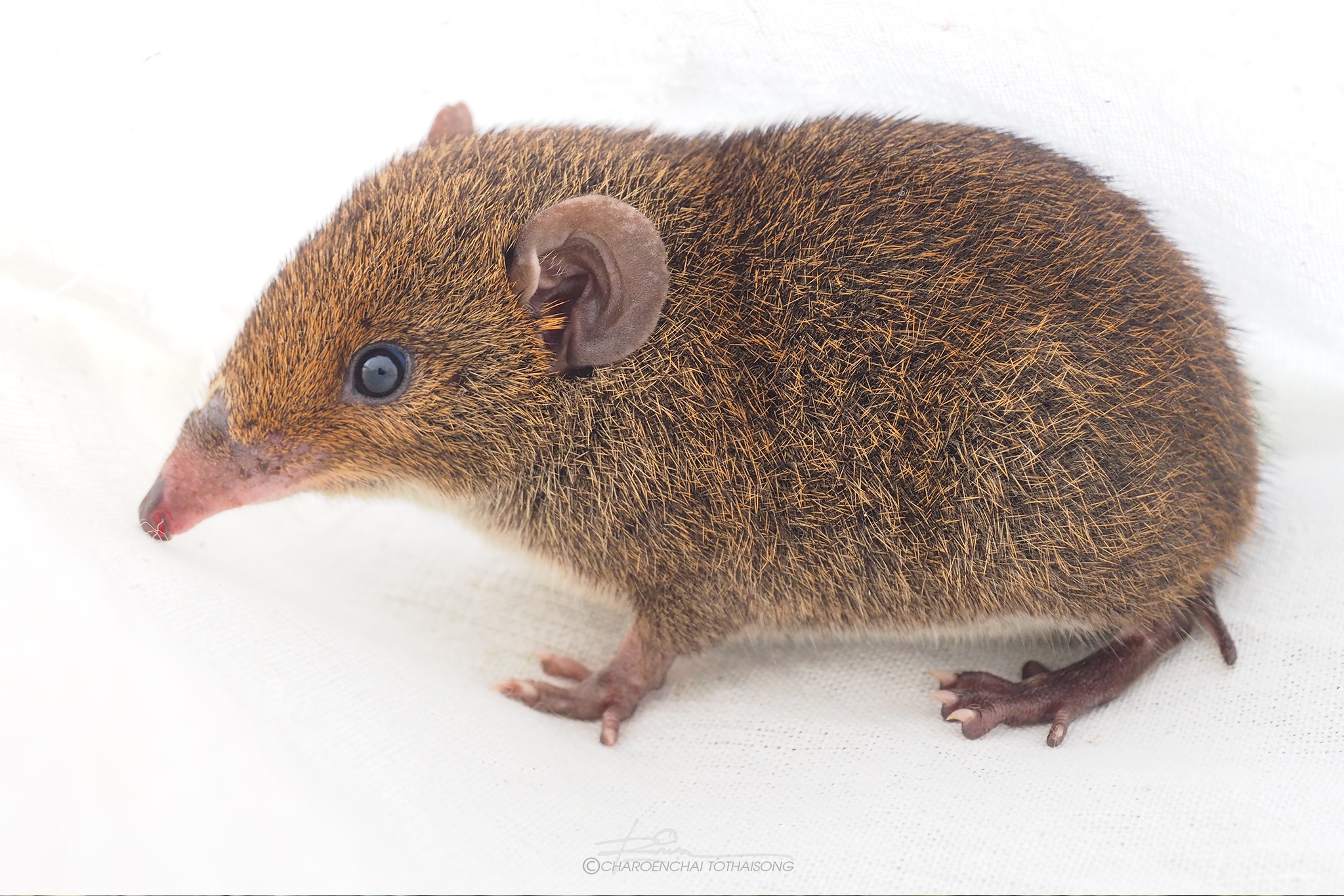
- NECurrent status: Not Evaluated
- DD
- LC
- NT
- VU
- EN
- CR
- RE
- EW
- EX
Current status: Not Evaluated
What does this mean?
This species has not been assessed yet.
Categories follow the IUCN Red List.Not Assessed
- Kingdom
- Animalia
- Phylum
- Chordata
- Class
- Mammalia
- Order
- Eulipotyphla
- Family
- Erinaceidae
- Subfamily
- Galericinae
- Genus
- Hylomys
- Species
- Hylomys peguensis
- Species group
- Gymnure
Get to know this species
Biology & ecology
Habitat
It inhabits hilly lowland to moderate elevation forests, from about 100 to 1,000 meters above sea level, living in diverse habitats such as river valleys, dry evergreen or deciduous woodlands, thick undergrowth, and grassy forest edges.
Physical traits
A moderate-sized gymnure, it measures approximately 10–15.7 cm in body length, with a tail around 1.7–2.5 cm (~17 % of body length), and weighs between 45 and 73 g. Its fur is typically light brown on top and yellowish-brown to silvery below, with pale feet and a bicolored tail.
Behavior
The Northern Short-tailed Gymnure is assumed to be primarily ground-dwelling and mostly nocturnal, but does appear capable of limited climbing and may also be active during the day. Weak field observations, such as multiple captures of males and females in the same trap, suggest possible pairing behavior or overlapping territories during reproductive periods.
Diet
This species is omnivorous with an insectivorous bias, feeding on insects like beetles, ants, butterfly larvae, and snails. In parts of its range, it will also consume fruits such as figs or vegetation from the genus Melastoma.
Reproduction
Breeding likely occurs in spring to early summer, based on increased testes size in males (March) and pregnant females observed in late February and May. Documented litter sizes include two to four young.
Communication
Direct observations are lacking. It is likely to rely on scent marking, tactile cues, and potentially soft vocalizations, consistent with related gymnure species, particularly for mating or territorial interactions.
Threats
The Northern Short-tailed Gymnure is not yet separately assessed by the IUCN and remains grouped under the Short-tailed Gymnure, which is generally classified as Least Concern. However, its dependence on forested habitats means that deforestation and land conversion may pose threats. It occurs in several protected areas across its range.
This species as pets
There are no known records of the Northern Short-tailed Gymnure being kept in captivity. Its elusive nature and specialized habitat needs make it unlikely to be part of captive programs, and conservation is necessarily focused on habitat protection and wild monitoring.
Where does it live?
This gymnure occurs across mainland Southeast Asia, including Myanmar, Thailand, Laos, Cambodia, Vietnam, and parts of Malaysia.
Linked Knowledge Hub articles
No linked public Knowledge Hub articles yet.
Linked research
No linked public research records yet.
Sources
Referenced sources
- Arlo Hinckley, Miguel Camacho-Sanchez, Marcus A H Chua, Manuel Ruedi, Darrin Lunde, Jesús E Maldonado, Hasmahzaiti Omar, Jennifer A Leonard, Melissa T R Hawkins, An integrative taxonomic revision of lesser gymnures (Eulipotyphla: Hylomys) reveals five new species and emerging patterns of local endemism in Tropical East Asia, Zoological Journal of the Linnean Society, Volume 202, Issue 2, October 2024, zlad177, https://doi.org/10.1093/zoolinnean/zlad177 Open source