
Dwarf gymnure
Hylomys parvus
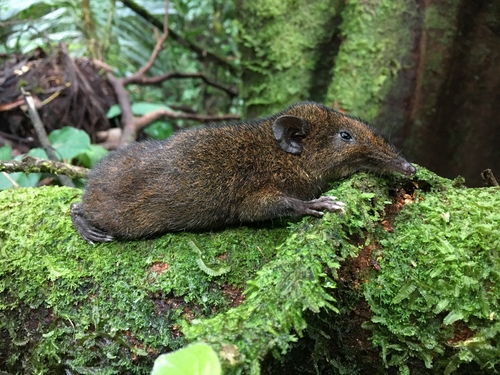
First described in 1998 by Robinson and colleagues, the Dwarf Gymnure is one of the smallest known members of the Erinaceidae family and is unique for its extremely limited distribution in central Sumatra’s montane forests.
- NE
- DD
- LC
- NT
- VUCurrent status: Vulnerable
- EN
- CR
- RE
- EW
- EX
Current status: Vulnerable
What does this mean?
This species faces a high risk of extinction in the wild.
Categories follow the IUCN Red List.Endangered
- Kingdom
- Animalia
- Phylum
- Chordata
- Class
- Mammalia
- Order
- Eulipotyphla
- Family
- Erinaceidae
- Subfamily
- Galericinae
- Genus
- Hylomys
- Species
- Hylomys parvus
- Species group
- Gymnure
Get to know this species
Biology & ecology
Habitat
It prefers dense undergrowth and moist soil, often near streams or areas with thick ground cover. Its known range is extremely small, and it has only been recorded in a few locations, making its habitat highly vulnerable to disturbance.
Physical traits
This species is tiny, with adults weighing only about 15–30 grams and measuring less than 10 cm in body length. It has a short, pointed snout, large eyes, and soft, coarse fur that ranges from grey to brown. Its tail is very short, barely visible beneath the fur, which helps distinguish it from related species. The ears are relatively large for its size, and its feet are adapted for walking through dense vegetation. Its delicate appearance contrasts with its tough survival needs in highland forest terrain.
Behavior
The Dwarf Gymnure is thought to be nocturnal and solitary, foraging alone at night and hiding in dense ground vegetation during the day. Because of its tiny size and elusive behavior, it is rarely observed in the wild. It likely spends most of its time foraging for insects and small invertebrates among leaf litter and moss. Unlike true hedgehogs, it cannot rely on spines for protection and instead depends on stealth and camouflage to avoid predators.
Diet
The Dwarf Gymnure is an insectivore, feeding on small insects, larvae, worms, and other invertebrates. Its pointed snout is well-suited for probing soil and leaf litter. The species is likely opportunistic and may also consume fungi or decaying plant matter when available. Due to its small size, it needs to feed frequently to maintain energy levels.
Reproduction
There is no direct information available on the reproductive habits of the Dwarf Gymnure. Based on related species, it is likely that females give birth to one to three offspring in a nest hidden in dense vegetation or under logs. The young are probably born blind and hairless, developing quickly over the course of several weeks. Breeding may occur during the warmer, wetter parts of the year, depending on resource availability.
Communication
Very little is known about communication in this species, but like other gymnures, it may use vocalizations, body postures, and scent marking to interact with others, especially during the breeding season. It likely has well-developed olfactory glands that help define territory and signal reproductive status. Observations are lacking, but parallels with related species suggest it may grunt or hiss when disturbed.
Threats
The Dwarf Gymnure is listed as Endangered by the IUCN due to its extremely small range, low population density, and the ongoing loss of montane forest habitat in Vietnam. Logging, agricultural expansion, and infrastructure development pose significant risks. Its limited distribution makes it highly susceptible to local environmental changes, and even small-scale disturbances could threaten its survival.
This species as pets
There are no known records of the Dwarf Gymnure being kept in captivity. Its small size, specific habitat needs, and rarity make it poorly suited for captive care or display. Conservation of the species depends entirely on the protection of its natural forest environment.
Where does it live?
The pygmy gymnure is endemic to central Sumatra, where it inhabits evergreen montane forests at an altitude of approximately 1,200–1,800 meters.
Linked Knowledge Hub articles
No linked public Knowledge Hub articles yet.
Linked research
No linked public research records yet.
Sources
Referenced sources
- Arlo Hinckley, Miguel Camacho-Sanchez, Marcus A H Chua, Manuel Ruedi, Darrin Lunde, Jesús E Maldonado, Hasmahzaiti Omar, Jennifer A Leonard, Melissa T R Hawkins, An integrative taxonomic revision of lesser gymnures (Eulipotyphla: Hylomys) reveals five new species and emerging patterns of local endemism in Tropical East Asia, Zoological Journal of the Linnean Society, Volume 202, Issue 2, October 2024, zlad177, https://doi.org/10.1093/zoolinnean/zlad177 Open source
- Clayton, E. 2018. Hylomys parvus. The IUCN Red List of Threatened Species 2018: e.T10589A22325019. https://dx.doi.org/10.2305/IUCN.UK.2018-1.RLTS.T10589A22325019.en. Accessed on 17 October 2026. Open source