
Bornean short-tailed gymnure
Hylomys dorsalis
First described in 1888 by Thomas, the Bornean Short‑tailed Gymnure was long considered a subspecies related to the Javan gymnure, but in 2023 was elevated to full species status, standing out by its short tail and mountain forest habitat.
- NECurrent status: Not Evaluated
- DD
- LC
- NT
- VU
- EN
- CR
- RE
- EW
- EX
Current status: Not Evaluated
What does this mean?
This species has not been assessed yet.
Categories follow the IUCN Red List.Not Assessed
- Kingdom
- Animalia
- Phylum
- Chordata
- Class
- Mammalia
- Order
- Eulipotyphla
- Family
- Erinaceidae
- Subfamily
- Galericinae
- Genus
- Hylomys
- Species
- Hylomys dorsalis
- Species group
- Gymnure
Get to know this species
Biology & ecology
Habitat
It inhabits moist montane forests, ranging from oak-moss forests and bamboo patches to grassy forest edges and even areas near buildings in protected reserves.
Physical traits
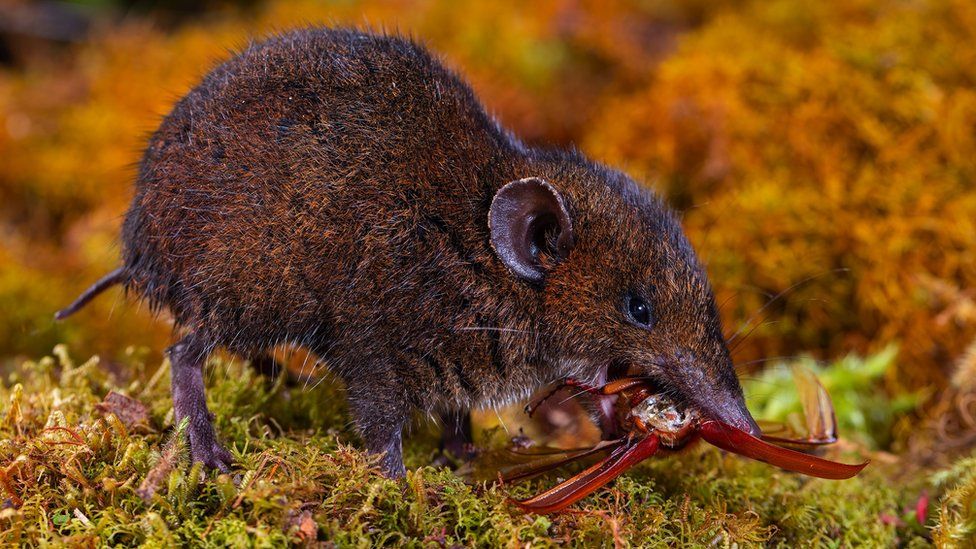
It is a small, shrew-like mammal with a body length of about 9–15 cm, a very short tail (1–3 cm), and a weight of 20–80 grams . Its fur is soft and dense, reddish-brown on the back, yellowish-gray underneath and may bear a dark mid-back stripe.
Behavior
This gymnure is primarily ground-dwelling, occasionally climbs low vegetation, and appears to be active both day and night. It creates narrow trails through dense underbrush for efficient movement.
Diet
Stomach content analyses reveal a diet rich in insects, earthworms, centipedes, beetle larvae, and occasionally tapioca and banana bait, indicating opportunistic omnivory.
Reproduction
Reproduction occurs at various times: pregnant females in mid-July, lactating in August–December, and juveniles captured in March suggest an extended or multiple breeding periods.
Communication
While no detailed studies exist, like other gymnures, it likely relies on scent marking and tactile interactions. Its subtle body language and chemical cues probably serve in territorial and mating contexts.
Threats
Currently not evaluated separately by the IUCN, its range overlaps with that of the broader “Short‑tailed Gymnure,” which is listed as Least Concern. However, as a highland specialist, it may be vulnerable to climate change and habitat loss . It is found in several protected areas across northern Borneo.
This species as pets
There are no records of the Bornean Short‑tailed Gymnure in captivity. Its elusive behavior and specialized montane habitat make it unlikely to be maintained outside its natural environment.
Where does it live?
This species is endemic to northern Borneo, known from several mountain ranges including Kinabalu, Trus Madi, Murud, Mulu, and Crocker, typically between 1,000 and 3,400 meters above sea level.
Linked Knowledge Hub articles
No linked public Knowledge Hub articles yet.
Linked research
No linked public research records yet.
Sources
Referenced sources
- Arlo Hinckley, Miguel Camacho-Sanchez, Marcus A H Chua, Manuel Ruedi, Darrin Lunde, Jesús E Maldonado, Hasmahzaiti Omar, Jennifer A Leonard, Melissa T R Hawkins, An integrative taxonomic revision of lesser gymnures (Eulipotyphla: Hylomys) reveals five new species and emerging patterns of local endemism in Tropical East Asia, Zoological Journal of the Linnean Society, Volume 202, Issue 2, October 2024, zlad177, https://doi.org/10.1093/zoolinnean/zlad177 Open source