
Moonrat
Echinosorex gymnura
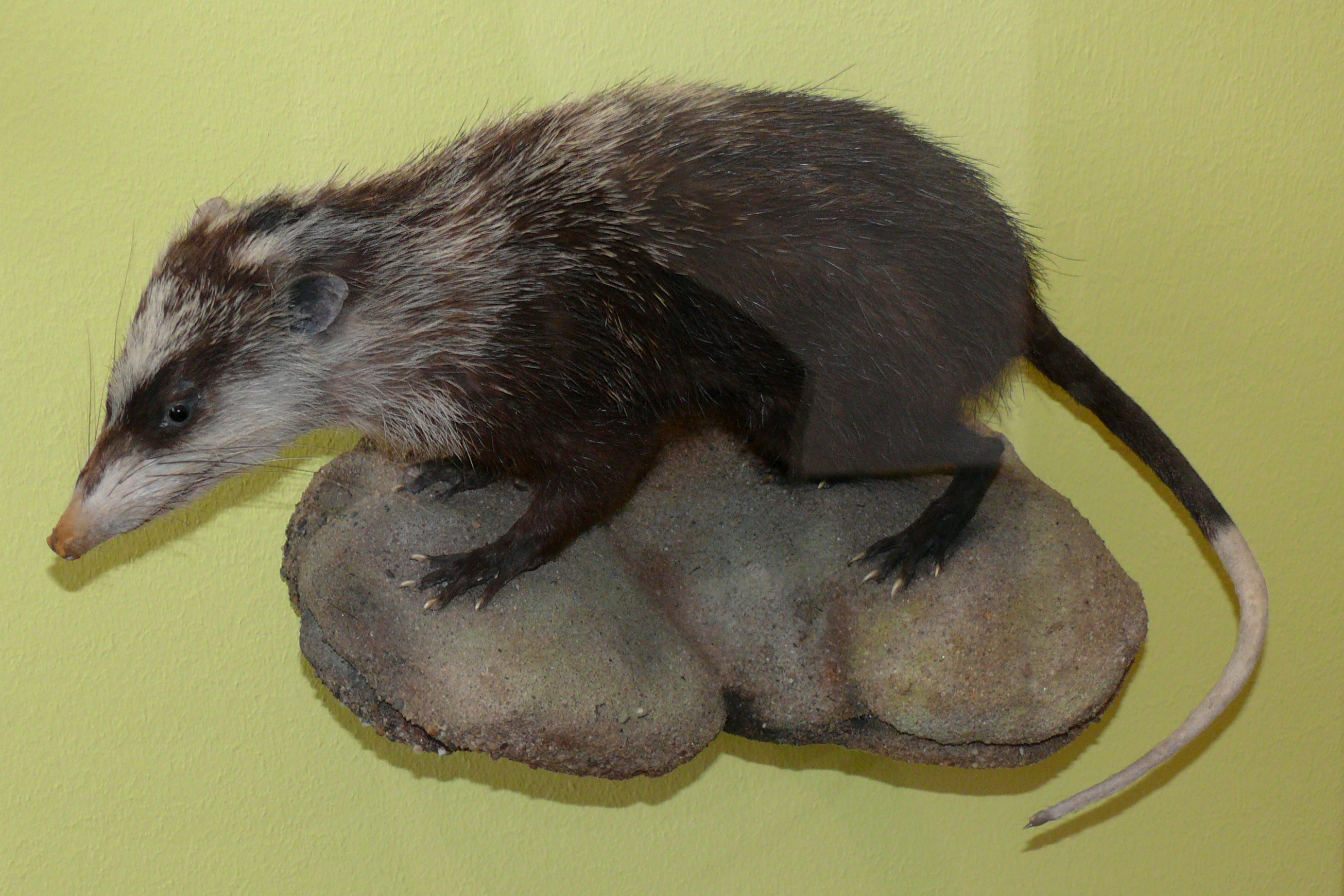
First described in 1821 by Thomas Horsfield, the Moonrat is one of the largest insectivorous mammals and is the only species in its genus, with a strong musky odor and striking color variation unlike any hedgehog.
- NE
- DD
- LCCurrent status: Least Concern
- NT
- VU
- EN
- CR
- RE
- EW
- EX
Current status: Least Concern
What does this mean?
The assessment found a lower risk of extinction.
Categories follow the IUCN Red List.- Kingdom
- Animalia
- Phylum
- Chordata
- Class
- Mammalia
- Order
- Eulipotyphla
- Family
- Erinaceidae
- Subfamily
- Galericinae
- Genus
- Echinosorex
- Species
- Echinosorex gymnura
- Species group
- Gymnure
Get to know this species
Biology & ecology
Habitat
They inhabit dense tropical rainforests, swamps, and sometimes secondary forests near rivers or streams. They prefer moist environments and are often found in lowland forest undergrowth with plenty of cover. Though elusive, they are not strictly limited to pristine forests and may tolerate lightly disturbed areas.
Physical traits
The Moonrat has a long, slender body reaching up to 32–40 cm in length, with a naked tail nearly as long as its body. Adults can weigh over 1 kg. Unlike hedgehogs, Moonrats have no spines; instead, they are covered in shaggy, coarse fur that varies from pure white to dark grey or black, with distinct regional color forms. They have a long, pointed snout, small eyes, and large ears. A powerful scent gland near the tail releases a strong ammonia-like odor, which is believed to deter predators.
Behavior
Moonrats are nocturnal and primarily solitary. They move swiftly through the undergrowth and forage along forest floors, sometimes near water. They do not hibernate and are active year-round. Unlike hedgehogs, they cannot roll up and instead rely on speed, camouflage, and scent for protection. When threatened, they may emit loud hissing or growling sounds and release their strong musky odor. They sleep in hidden nests made of leaves or grass during the day and are rarely seen unless disturbed.
Diet
Moonrats are insectivores, but their diet is quite varied. They feed on insects, earthworms, small vertebrates, crustaceans, and even rotten fruit or fungi. They use their long snouts to root through soil and leaf litter, probing crevices with their sensitive noses. They are opportunistic feeders and may also scavenge dead animals when available. Their digestive system is adapted to high-protein, animal-based food sources.
Reproduction
Breeding in Moonrats is not well studied, but they are believed to have one to two offspring per litter. The young are born in a sheltered nest and are altricial, meaning they are born blind, hairless, and completely dependent on the mother. They grow rapidly and begin to leave the nest within a few weeks. Females care for the young alone. There is no defined breeding season in tropical regions, and reproduction may occur year-round depending on food availability.
Communication
Moonrats are known for being vocal, using grunts, growls, and hisses to communicate. They also use scent marking to establish territory and possibly attract mates. The foul-smelling secretions from their scent glands likely serve both as a warning to intruders and as a chemical signature. While their vision is limited, their keen sense of smell and hearing helps them detect prey and avoid danger in the dark.
Threats
The Moonrat is listed as Least Concern by the IUCN, but its populations are affected by deforestation, habitat fragmentation, and in some areas, hunting. Its preference for humid forests makes it vulnerable to large-scale logging and land conversion. However, it is still widely distributed and relatively adaptable to disturbed habitats, which has helped it persist in many areas despite environmental pressures.
This species as pets
Moonrats are rarely kept in captivity and are generally considered unsuitable for domestic care. They are shy, sensitive to stress, and have very specific environmental needs, including high humidity and a protein-rich diet. Their strong odor also makes them undesirable in home settings. In zoological collections, they are occasionally displayed in Southeast Asian exhibits but remain rare due to their secretive nature and care requirements.
Where does it live?
Moonrats are found in Southeast Asia, including Peninsular Malaysia, southern Thailand, Sumatra, and Borneo.
Linked Knowledge Hub articles
No linked public Knowledge Hub articles yet.
Linked research
No linked public research records yet.
Sources
Referenced sources
- Cassola, F. 2016. Echinosorex gymnura. The IUCN Red List of Threatened Species 2016: e.T40603A22326807. https://dx.doi.org/10.2305/IUCN.UK.2016-2.RLTS.T40603A22326807.en. Accessed on 17 October 2026. Open source